
Last updated: June 13, 2026 Some links are affiliate links — see our Affiliate Disclosure.
China Entry Requirements 2026: Documents & Arrival Card
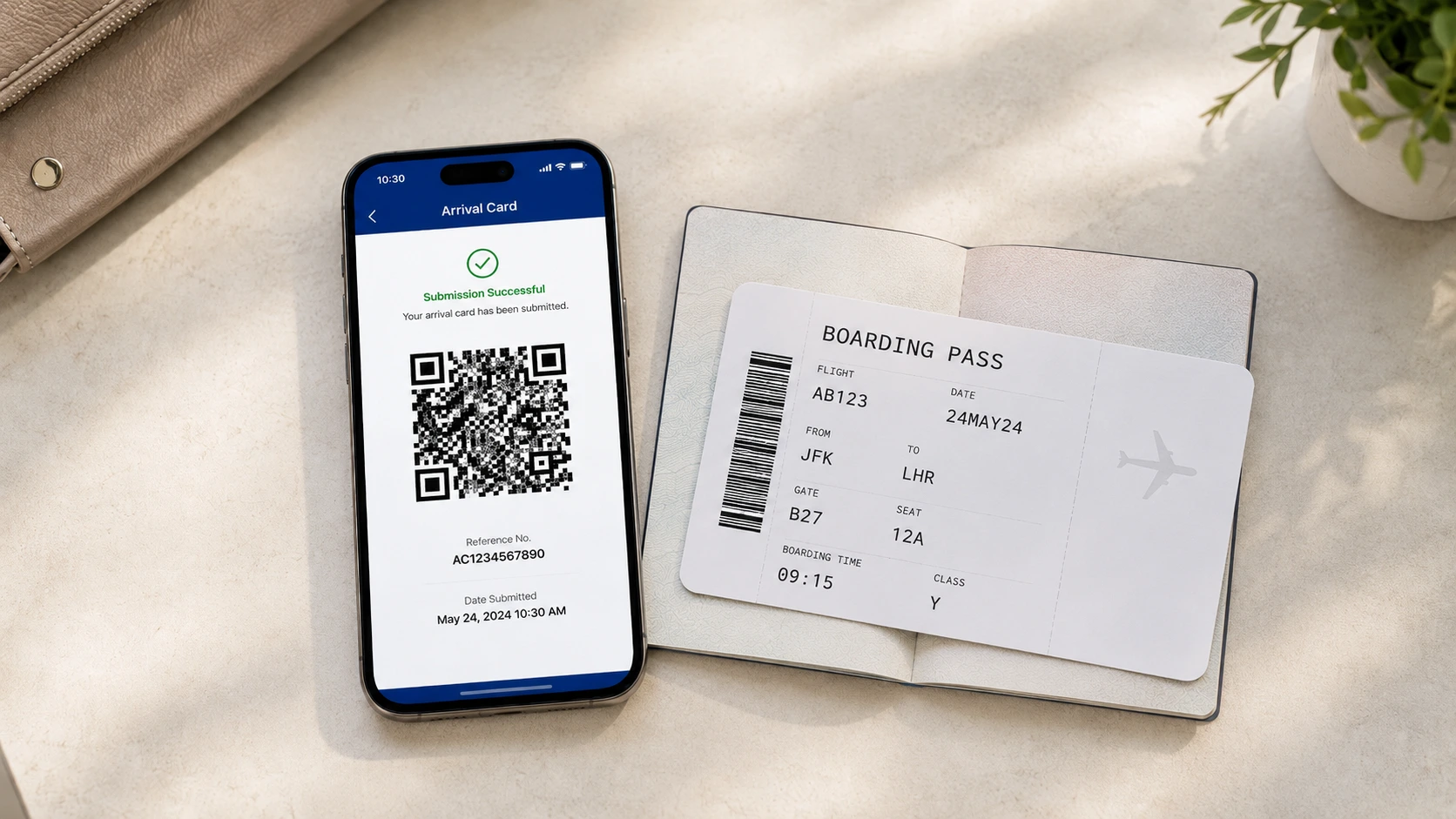
Immigration lines are not where you want surprises. Most border problems come down to small, avoidable things — a missing hotel address, an arrival card filled out wrong, something packed that shouldn't be. Here's everything to have ready before you fly, step by step from landing to the arrivals hall.
What This Page Covers
This guide covers the documents and steps for visa-free entry into China under any of the major policies: the 30-day visa-free policy, the 240-hour transit policy, mutual visa exemption agreements, and Hainan's 30-day policy.
It's not about whether you qualify — if you need that, start with which policy applies to your passport. This page assumes your route works. Now you need to know what to carry and do when you land.
One thing to keep in mind as you read: we're a travel guide, not an official government site. Entry rules can change, so always double-check the official policy (the sources at the bottom of this page, or China's immigration hotline 12367) before you book.
Your Passport: The One Non-Negotiable
How long your passport must stay valid depends on the policy: the 240-hour transit policy requires at least 3 months of validity, and the 30-day policy requires a valid ordinary passport covering at least your whole stay. But here's the practical advice: airlines and border officers like to see at least 6 months. If your passport expires within 6 months, renew it before you book anything — an almost-expired passport is the fastest way to get turned away at check-in, and there's no grace period.
Two more things: your passport needs at least one blank page for the entry stamp, and if you hold more than one passport, the one you show at Chinese immigration must be from a country that qualifies for the policy you're using.
Documents You Must Carry
Required at immigration:
- Your passport or travel document required by the policy you're using. For the 30-day visa-free policy, this means a valid ordinary passport. For the 240-hour transit policy, NIA requires a valid international travel document with at least 3 months' validity.
- A confirmed onward or return ticket — required for the 240-hour transit policy (to a third country, within the 240-hour window); not officially required for the 30-day policy, but airlines and officers may ask, so have it anyway
- Your arrival card
- Your accommodation address in China — hotel name and address, or the address where you'll stay
Having everything on this list makes entry routine — but the final decision always belongs to the immigration officers at the border.
Documents That Help (Recommended)
Not legally required, but officers may ask, and having them ready makes everything smoother:
- Hotel booking confirmation — printed or a screenshot, showing your name, dates, and the hotel address
- A simple one-page itinerary — which cities, which dates
- Proof you can support yourself — a credit card or some cash is enough
- A return ticket even if your policy doesn't require one
For the hotel booking itself, stick to the big platforms — Trip.com or Booking.com. A confirmation from a major platform is exactly the kind of proof immigration officers are used to seeing. Trip.com is China-native, so it's the most convenient for the mainland — the biggest hotel selection, and plenty of refundable, free-cancellation options if your plans might shift.
The Arrival Card: How It Works Now
Most foreign travelers entering China need to complete an arrival card, and it can now be filled out online before arrival. A few categories are exempt, such as certain permanent residents, eligible group-visa or group visa-free travelers, some direct 24-hour transit passengers who don't leave the port area, and transport crew.
Fill it in online before you arrive, through the official NIA arrival card website. Do it within the 72 hours (3 days) before you land — any time inside that window works. You'll get a QR code confirmation to show at immigration — take a screenshot and save it to your camera roll, so you can pull it up even with no internet.
And be aware of fraud: only use the official website above. There are plenty of scam sites that look official and charge money for this form — the real arrival card is always free.
What the Arrival Card Asks For
Have these ready:
- Your name, nationality, passport number, date of birth (exactly as in your passport)
- Purpose of visit — pick the one that matches your policy: tourism, business visit, or transit
- Flight number, arrival date, and port of entry (that's just the place where you enter China — usually the airport you land at)
- Your accommodation address in China
- Length of stay
- Your departure date and flight, if you've already booked it
Common Mistakes to Avoid
- Don't write just "hotel" as your address. Use the actual name and address — your first night's hotel is fine.
- Match the purpose to your policy. Entering under the 240-hour transit policy? Select transit. Tourism under the 30-day policy? Select tourism.
- Make sure your dates match your ticket and your real arrival date.
If you didn't fill it in before flying, you can usually complete it at the port using official QR codes, smart devices, or paper cards. Having your eSIM already working or your VPN set up helps too. But doing it before departure is still easier — airport Wi-Fi, queues, and on-site setup can vary, so home is the stress-free option.
What You Can and Can't Bring Into China
Prohibited — Don't Pack These at All
- Firearms, ammunition, explosives
- Illegal drugs
- Counterfeit currency
- Obscene or politically sensitive materials
- Fresh meat, dairy, eggs, and fruit (biosecurity rules)
- Endangered-species products (ivory, certain skins and furs)
Getting caught with any of these means confiscation, fines, or worse.
Allowed but Limited — Declare If You're Over
- Alcohol: up to 1.5 liters duty-free (drinks 12% alcohol and above)
- Tobacco: up to 400 cigarettes, 20 cigars, or 500g of tobacco duty-free. If entering from Hong Kong or Macao, these limits are generally halved.
- Cash: declare foreign currency cash over USD 5,000 or equivalent. RMB cash is limited to RMB 20,000 per person; amounts above that may be prohibited or seized under currency-control rules.
- Prescription medication: fine in personal quantities — keep it in the original labeled packaging and bring your prescription or a doctor's note. Declare large quantities.
If you're not sure whether something needs declaring, declare it. Better to ask and get waved through than to get stopped. Customs limits can change too — check the official customs rules before you fly if you're carrying anything close to a limit.
Customs: Red Channel or Green Channel
After you collect your luggage, you'll see two exits: the green channel (nothing to declare) and the red channel (something to declare).
Most tourists have nothing to declare and walk straight through the green channel — no form, no stopping. If you're over any limit above, take the red channel and declare it to the officer.
Be honest about it — the green channel has random bag checks, and declaring takes a few minutes while getting caught not declaring can cost you the items, a fine, or worse.
Step-by-Step: What Happens When You Land
- Follow the Arrivals signs to the immigration hall. Have your passport and arrival card QR code in your hand, not buried in your bag.
- Self-service fingerprint machines. At many airports, right after you leave the plane and before immigration, you'll pass self-service screens where you collect your own fingerprints. Choose your language on the screen and follow the steps — it takes a minute and the machine guides you through it.
- Join the right line — look for "Foreign Nationals" (or a dedicated visa-free/transit lane at bigger airports). Not sure? Ask a staff member.
- Hand over your documents — passport open to the photo page, arrival card confirmation, onward ticket if your policy needs one.
- Answer a few simple questions. Why are you visiting? How long? Where are you staying? Always be honest — tell your true story and your true intentions, and you should be fine.
- Photo and fingerprints at the counter. The officer takes your photo and scans your fingerprints — even if you already did the fingerprint machines earlier, they'll often scan again at the counter as part of their protocol. Standard for all foreign visitors.
- Entry approved. The officer stamps your passport with your entry date and permitted stay. Keep your passport with you in China — you'll need it for hotels and train tickets.
- Luggage, then customs — green channel if nothing to declare, red if something. Then you're officially in China.
If You're Pulled Aside for Questions
It happens occasionally and it's usually routine. Common reasons: your documents don't match (arrival card says one hotel, booking says another), your transit route doesn't fit the policy, something's missing, or a random check.
Stay calm, answer clearly, and show whatever they ask for — bookings, itinerary, tickets. If an officer decides you don't meet the requirements, they can refuse entry and send you back at your own expense. That's rare when your documents are in order.
Questions before you fly? China's immigration hotline is 12367.
After You Land: Register Within 24 Hours
One more legal step once you're in China: every foreign visitor's address gets registered with the local police within 24 hours.
Staying in a hotel? It happens automatically at check-in — you do nothing. Staying with a friend or in a private rental? You or your host register your stay at the local police station within 24 hours — it's a routine procedure in China, and your host can help you with it.
Since March 2026, China has also begun piloting online accommodation registration for foreigners staying outside hotels in some regions. Where available, your host may be able to complete the registration online through official NIA channels instead of going to a police station in person.
Pre-Flight Checklist
- Passport valid (6 months is the safe standard), with blank pages
- Onward or return ticket confirmed
- Hotel booking confirmation saved offline
- Simple itinerary written down
- Arrival card filled in online before you fly, QR code screenshot saved
- No prohibited items packed, nothing over the customs limits — or ready to declare
- Cards or some cash for proof of funds
- Copies of everything (passport photo page, tickets, bookings) on your phone
- VPN installed and tested before departure — you can't download one inside China
- China eSIM ready to switch on when you land
- WeChat and Alipay downloaded, card linked (set up a few days early — verification can take 24 hours)
New to China? Our complete first China trip guide walks through every step — payments, apps, internet, maps, and everything else worth having ready before your first trip. And if you want all of it in one place, there's the big PDF guide: every visa-free way into China explained, step-by-step instructions with photos and screenshots — how to install Alipay and WeChat, connect your card, order a taxi — and our picks for the major cities, from the classic sights to the spots blowing up on social media. Everything from policies to apps to what to pack. Buy it once, it's yours forever.
FAQ
Do I need a paper arrival card if I filled it out online?
No — the QR confirmation from the official website is what you show at immigration. If a particular port asks you to redo it on their devices, just do it there; it's the same short form.
What if I don't have a hotel booked yet?
You need an accommodation address for the arrival card and for immigration if asked. Book at least your first night before you fly — refundable if your plans might change.
Can I bring my prescription medication into China?
Yes — original labeled packaging, with your prescription or a doctor's note. Declare large quantities. If your medication is a controlled substance, check China's rules for it before you pack.
What if I'm traveling with family?
Each person needs their own passport and arrival card — children included. Parents fill out the forms for young kids.
Do I need travel insurance to enter China?
It's not an entry requirement, but it's smart to have — medical care for foreigners can get expensive, and your home insurance probably doesn't cover you in China.
What if my flight is delayed and I miss my onward connection?
If you're on the 240-hour transit policy, contact your airline immediately and get a new confirmed ticket within your 240-hour window. If the delay pushes you past the limit, contact the immigration hotline 12367 or the local exit-entry administration before your time runs out — don't just overstay.
Can I leave China and come back on the same visa-free entry?
No — each entry is its own visa-free stay. Once you leave, that stay ends. You can enter again if you meet the policy requirements again on the new trip.
What if I lose my passport while in China?
Report it to the local police, get a replacement document from your embassy or consulate, then go to the immigration office for an exit permit. Start immediately — don't wait until your departure day.
Where do I book tours and activities in China?
Day trips, attraction tickets, and guided tours can be booked ahead on Trip.com and Klook — the go-to platforms for activities across China's major cities.
Sources
- National Immigration Administration — Visa-Free Transit Policies
- National Immigration Administration — List of Countries Covered by Unilateral Visa Exemption Policies
- Ministry of Foreign Affairs — FAQs on Visa-Free Entry into China
- General Administration of Customs — Customs Clearance Guide for International Passengers
Bottom Line
Visa-free entry into China is straightforward when your documents are ready: a valid passport, your digital arrival card, an onward ticket if your policy needs one, and your hotel address. Fill in the arrival card online before you fly, stay inside the customs limits (or declare), and answer the officer's questions simply and honestly. Final approval is always made by immigration inspection authorities at the port — but for prepared travelers, it's routine. Rules can change, so confirm against the official sources above before you book. Questions before you fly? China's immigration hotline is 12367.