
Last updated: July 17, 2026 Some links are affiliate links — see our Affiliate Disclosure.
Xi'an Visa-Free Travel Guide: Terracotta Army and Top Things to Do

Xi'an is one of China's most famous cities, and one of the top spots on most travelers' bucket lists. The Terracotta Army alone attracts millions of visitors a year. It was China's capital for more than a thousand years and the start of the Silk Road, and today it has some of the country's greatest sights and some of its best food. This guide covers how to get there, what to see, where to eat, and how to plan your time, with a few honest tips from locals along the way.
Can you visit Xi'an visa-free?
For many travelers, yes. China's visa-free policies let citizens of dozens of countries visit for anywhere from 10 to 30 days, and Xi'an's international airport is a valid entry point, so you can often fly straight in. To check exactly how your passport can enter China without a visa, see our China visa-free hub. The rest of this guide is about the city itself.
Getting to Xi'an
By air. Fly into Xi'an Xianyang International Airport (XIY). A metro line runs straight from the airport into the city, which is the cheapest and simplest way to get from the airport to the city centre. Ride-hailing is easy too. Didi is a taxi app that calls a car for you and has an English interface, and you can use it on its own or inside Alipay. Regular street taxis are also available if you would rather just grab a car without booking one, though they usually cost a bit more. If you take one, make sure the driver turns on the meter when you get in, because the fare is based on time and distance. With the meter running you see the exact amount, so also keep an eye on your map app to check they take a sensible route and not a longer one to push up the price. If a driver will not use the meter, just take another taxi.
By high-speed train. Xi'an North is one of China's biggest rail hubs, which makes it easy to combine Xi'an with other cities on one trip:
- Xi'an to Beijing: about 4.5 to 6 hours
- Xi'an to Shanghai: about 6 to 7.5 hours
- Xi'an to Chengdu: about 3 to 4.5 hours
- Xi'an to Luoyang: about 1.5 hours
You can book flights, trains, and hotels on Trip.com, a China-native platform that works in English and takes foreign cards.
The Terracotta Army: what you need to know
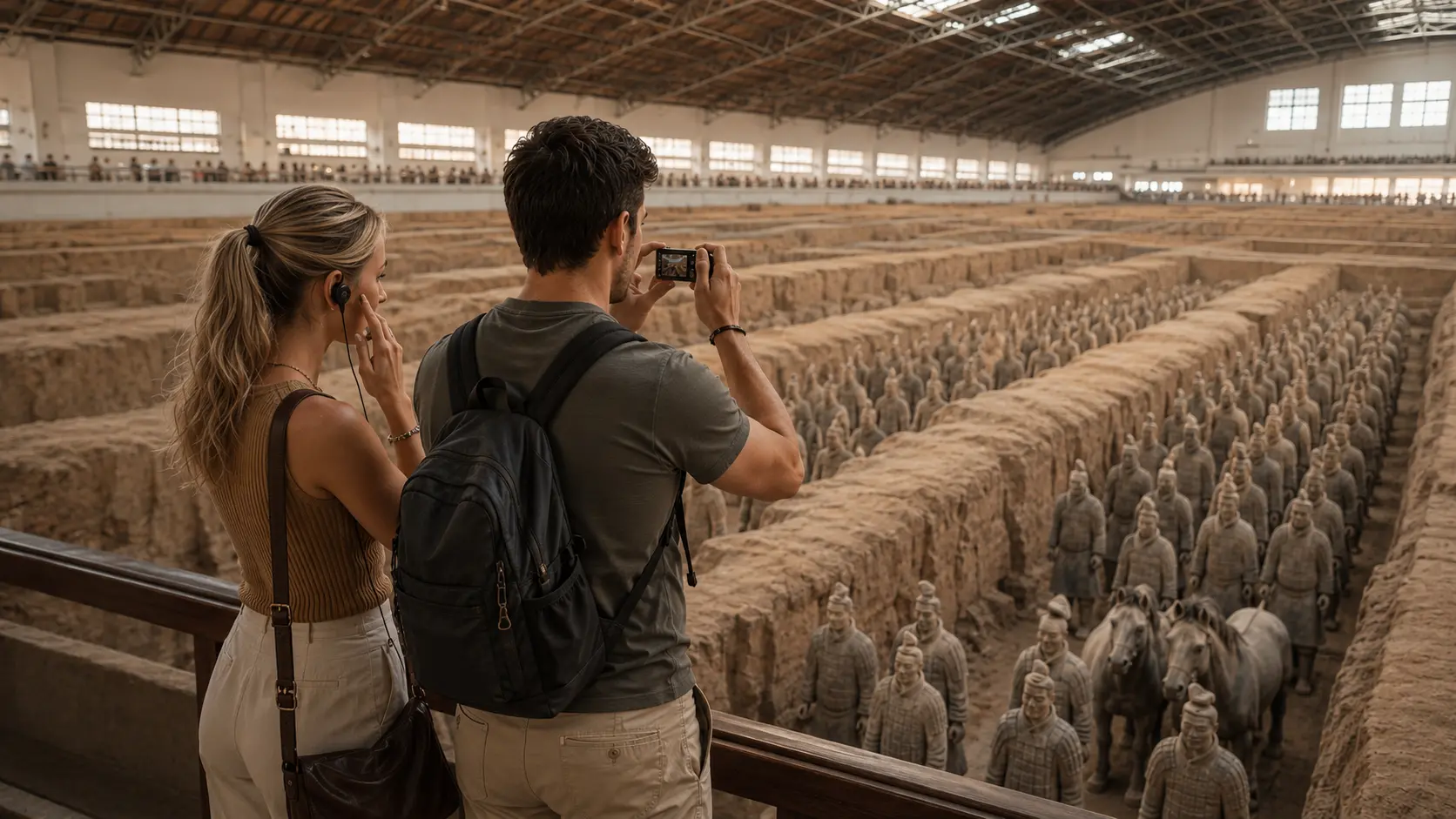
The Terracotta Army, officially the Museum of the Qin Terracotta Warriors and Horses, is located about 40 kilometres east of central Xi'an, near the town of Lintong. It is the reason most foreign visitors come to Xi'an.
Discovered in 1974 by farmers digging a well, the site holds more than 8,000 life-size soldiers, horses, and chariots, buried with China's first emperor, Qin Shi Huang, over 2,000 years ago to protect him in the afterlife. Every soldier has a different face.
The site is made up of three main pits, which are large covered halls you look down into. Pit 1 is the biggest and the most impressive, with row after row of standing soldiers. Pit 2 has horses and riders, archers, and foot soldiers arranged like an army ready for battle. Pit 3 is the smallest and was probably the command post, where the leaders would have been. A separate hall shows two beautiful bronze chariots found near the emperor's tomb.
How long to spend: at least two to three hours, or half a day if you want to read every sign and take your time.
Getting there: most travelers take a taxi, hire a private car, or book a half-day tour from Xi'an. Public bus 306 (also called tourist bus Line 5) runs from Xi'an Railway Station to the site, and is cheap but can be crowded. A taxi takes about 45 minutes to an hour.
Tickets: book ahead and go in the morning. Afternoons get very crowded, and tickets can sell out. You can book Terracotta Army tickets, skip-the-line entry, and guided tours in advance on Trip.com and Klook.
A guide is worth it: the site has English signs, but a good guide brings the history to life and points out details you would walk straight past, like which figures held which rank and where traces of the original paint survive. Rent the official audio guide, or join a proper tour, rather than taking a random freelance guide at the gate.
Xi'an's ancient city wall
Xi'an's city wall is one of the oldest and best-preserved in China. It dates from the Ming Dynasty in the 14th century, and it is 13.7 kilometres long, running the whole way around the old centre.
You can walk along the top, climb up just to enjoy the view, or rent a bike and ride all the way around the wall. The North Gate is the easiest place to rent a bike and to drop it back afterwards. When you rent, you usually leave a small cash deposit, which they give back to you once you return the bike, so keep some cash on you. At night the whole wall lights up and looks incredible. In summer, riding during the day is not ideal because it gets really hot up there with no shade, so late afternoon is a much better time. You can book city wall tickets ahead if you want to skip the queue.
The Muslim Quarter (Huimin Street)
The Muslim Quarter is Xi'an's famous food street and night market, packed with stalls, small restaurants, and shops. It is loud, crowded, and delicious, and it is impossible to visit Xi'an without walking through at least once.
The main street, Beiyuanmen, starts right behind the Drum Tower, and small side alleys lead off it in every direction. One honest tip from locals: the best food is usually in the small stalls down those side alleys, not the big shops on the main street with "time-honoured" or "ancestral recipe" signs. A lot of the most famous, most advertised snacks taste just okay and cost more than they should, so the trick is to eat where you see locals lining up.
The best time to visit the quarter is in the evening, when it is busiest and most lively.
Big Wild Goose Pagoda
The Big Wild Goose Pagoda (Dayan Ta) is a Tang-dynasty Buddhist pagoda from around 652 AD in southern Xi'an, built to house scriptures the monk Xuanzang brought back from India. It is one of the city's most recognizable landmarks.
The pagoda is part of a big Buddhist temple complex called the Da Ci'en Temple. You can book pagoda and temple tickets through the link to skip the line, then pay a little extra on the spot to climb up inside the pagoda itself, which is seven storeys tall. Here is a tip that could save you some money: you do not actually have to climb the pagoda for the view. The Joy City mall is right across the street from the pagoda, and its 4th-floor viewing deck gives you a great view for free. The square around the pagoda has gardens and a music-and-water fountain show most evenings that is free to watch.
A 3-day Xi'an itinerary locals recommend
The itinerary below is built from the places locals rate as the best to see in the city, and many tourists from all over China come to Xi'an to visit these spots. It covers the most famous spots and places, plus a few that most foreign guides don't know about. Treat it as inspiration rather than a fixed itinerary, and change the order of the days depending on what you want to see first.
Day 1: The old city
- Xi'an City Wall: rent a bike and ride around the city wall. In summer, go in the late afternoon rather than at noon, so it is not too hot.
- Bell Tower and Drum Tower: the two landmark towers in the centre, a few minutes apart
- The Muslim Quarter: the famous food lanes for lunch or dinner
- Sajin Bridge (Sajinqiao): a more local, less touristy food street nearby that Xi'an people love
- Gao Family Courtyard: a restored historic residence in the same area, known for its shadow-puppet shows
Day 2: The Terracotta Army and the hot springs
- The Terracotta Army: go in the morning to avoid the crowds
- Huaqing Palace (Huaqing Hot Springs): about 20 minutes from the Terracotta Army. A hot spring is a spot where naturally warm water rises up from deep underground, warm enough to bathe in, and people have used the warm water here for over 2,000 years. Chinese emperors loved it so much they built a palace around it, and the most famous story is a Tang emperor bathing here with his favourite, Yang Guifei. Today it is a historic park to walk around, with gardens, old pavilions, and the ancient stone pools the emperors bathed in, all with Mount Li rising up behind.
- Mount Li (Lishan): the mountain right next to Huaqing Palace. A cable car takes you up, and you can enjoy the view over the whole area during the ride
- The Song of Everlasting Sorrow: a famous outdoor evening show at Huaqing Palace, staged seasonally (usually the warmer months). Book the show ahead if you want to see it
Day 3: Tang-dynasty Xi'an
- Shaanxi History Museum: one of China's best, free entry but you must book a time slot in advance
- Big Wild Goose Pagoda: the Tang-era landmark and its fountain square
- Tang Paradise (Datang Furong Garden): a large Tang-themed park of gardens, pavilions, and water shows
- Datang Everbright City: the famous pedestrian street, beautifully lit and buzzing with performers at night, free to walk
- Yongxingfang: a Shaanxi food street known for biangbiang noodles and the "smash-the-bowl" wine
Want a plan built around you? If you would like us to design your perfect Xi'an itinerary, or help you plan a longer China trip across several cities, check out our custom trip-planning service.
We build a day-by-day plan around exactly what you want, starting from $129.
Where to eat in Xi'an
Xi'an is one of China's great food cities, and the eating is half the reason to come.
Beyond the Muslim Quarter, locals often prefer Sajin Bridge (Sajinqiao) for a more everyday version of the same street food, and Yongxingfang for specialities from across Shaanxi Province, the region around Xi'an.
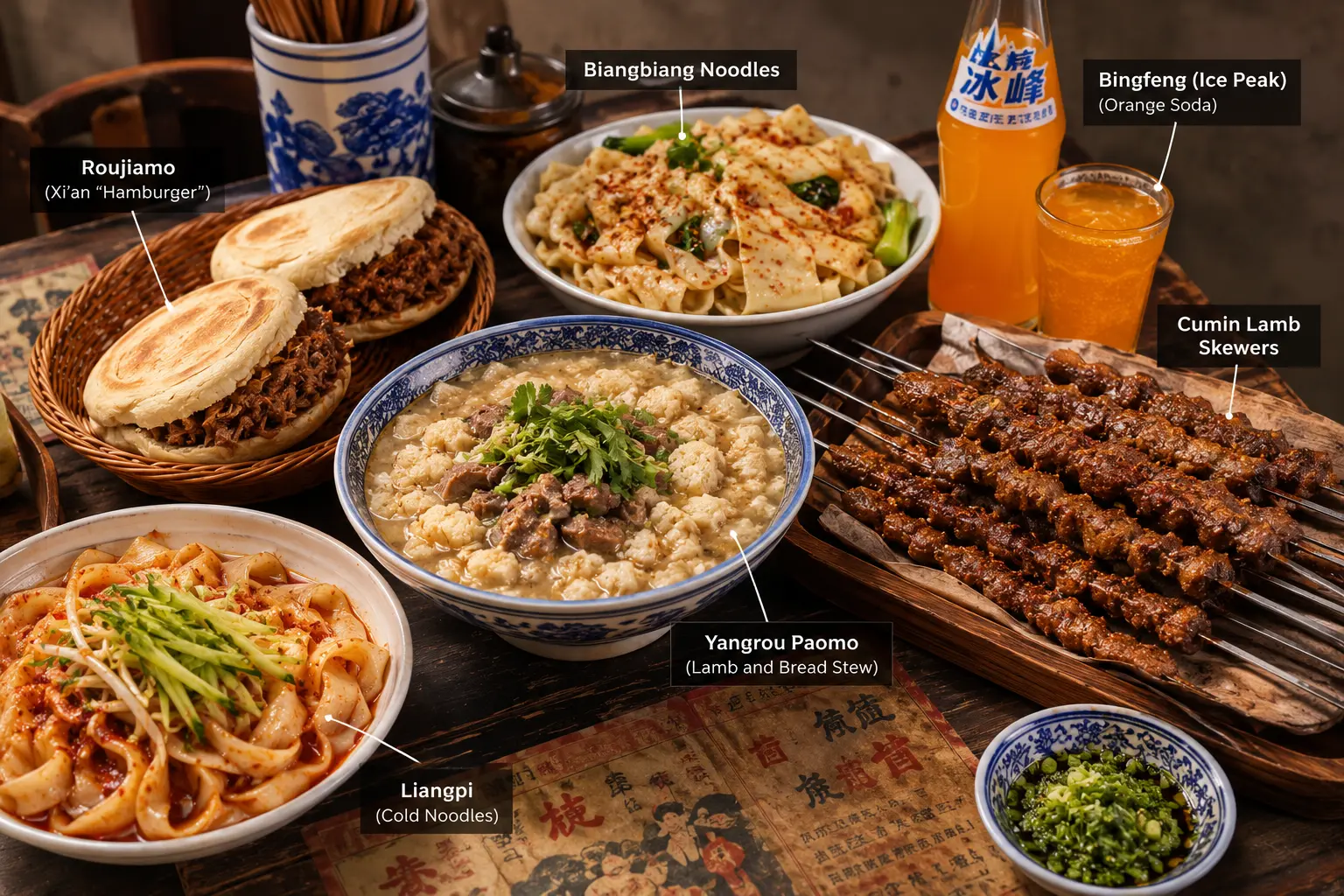
The dishes to try: roujiamo (the Xi'an "hamburger"), biangbiang noodles, yangrou paomo (lamb and bread stew), liangpi (cold noodles), and plenty of cumin-heavy lamb skewers. And be sure to try Bingfeng (Ice Peak), the orange soda Xi'an grew up on.
A few local favourites that Chinese food guides rate:
- Xiaowu Xi'an Traditional BBQ for a lively night of grilled skewers, grilled pineapple, and craft beer
- Tangrenli Shaanxi Cuisine (South Gate branch) for a proper sit-down Shaanxi meal with a city-wall view
- Li Shanshan for tea and matcha drinks when you need a break
- LEB³ Bakery for pastries and afternoon tea in a garden setting
To find any of these locations, just copy the name from this article into your Didi app, or show it to a taxi driver, and they will take you straight there.
Local tips: what locals want you to know
Xi'an is easy and safe, but a little insider knowledge saves you money and hassle. The honest version:
Getting around
- For getting between the sights, Didi (the taxi app) is the easiest option for most visitors. The metro is the second option. If you feel comfortable finding your way around it, it is cheaper and skips the traffic.
- Avoid the drivers who offer you a ride outside attractions and at the airport. These are private cars, not official taxis, and they often take a longer route and overcharge you. Use an official taxi, Didi, or the metro instead.
- Skip the local metro card (called Chang'an Tong). It is a rechargeable travel card for the buses and metro, but for a short visit you do not need one, because you can just pay by scanning your phone with Alipay or WeChat.
- Datang Everbright City gets very crowded at night, and when everyone starts to leave at the same time it is almost impossible to get a taxi there. Take the metro instead, or leave before the rush starts.
Food, shopping, and small scams
- Be careful with the "Lantian jade" sold outside the Terracotta Army. Lantian jade is a green stone from near Xi'an, made into bracelets, pendants, and small carvings. A lot of the pieces sold to tourists are fake or low quality and hard to tell apart, so it is easy to overpay unless you really know jade.
- Souvenirs and gift-shop items at the big sights are often mass-produced and much cheaper online, so do not buy on impulse.
- The "smash-the-bowl wine" at Yongxingfang is a local tradition where you drink a small bowl of rice wine, then throw the empty bowl on the ground to smash it for good luck. It is worth doing once for the photo, but leave it at that.
Shows and photos
- At Datang Everbright City you will see "follow-along" photographers. These are people you pay to walk with you and take photos and short videos as you stroll through the lit-up street, often in a rented traditional costume. If you hire one, agree the price and how many finished photos you will get before you start, so the final bill does not surprise you.
- The Song of Everlasting Sorrow is a famous outdoor night show at Huaqing Palace. Hundreds of performers act out a classic Tang-dynasty love story between an emperor and his favourite, Yang Guifei, with music, lights, and Mount Li lit up behind the stage. It is beautiful, but choose your seat by the view rather than the price. A seat in the centre, a little further back, is better than a cheaper one off to the side at the front.
Before you go
There are a few things that will make your China trip much easier if you take care of them before you fly:
- Book flights, trains, and hotels early on Trip.com. It has English and almost every other language, plenty of refundable, free-cancellation tickets, and the most reviews on Chinese hotels, since Chinese guests leave feedback there too. One tip on those reviews: sort them by the lowest score first, read the worst complaints, and check how recently they were written. Some hotels have glowing reviews left by bloggers who got a free stay, so the low reviews give you a truer picture of what a place is actually like.
- Think about your data before you arrive. Get a China eSIM or set up roaming so you have internet the moment you land.
- Set up your apps before you are in China. Google, Gmail, WhatsApp, and Instagram often do not work on normal Chinese networks, so install a VPN before you arrive. You usually cannot download one once you are in the country.
- Get the payment apps ready. Almost everything is paid by phone. Download WeChat and Alipay and link your card before you fly. Our guide to paying in China walks you through it, and our complete first-China-trip guide covers the rest.
FAQ
How do I get from Xi'an airport to the city centre?
The cheapest and easiest way is the metro, which runs straight from the airport into the city. You can also take a Didi (a taxi you order on an app, in English) or a normal taxi. Just avoid the private drivers who offer you a ride at the airport, because they overcharge.
How many days should I spend in Xi'an?
Two full days cover the Terracotta Army, the city wall, and the Muslim Quarter. Three days let you add the Shaanxi History Museum, the Big Wild Goose Pagoda, Datang Everbright City, and a trip out to Huaqing Palace.
Do I need to book Terracotta Army tickets in advance?
Yes, book ahead and go early. Afternoons are the busiest, and booking ahead saves you time and the risk of tickets selling out.
Where do I book tours and activities in Xi'an?
The two platforms most travelers use are Trip.com and Klook. Both list English-language tours to the Terracotta Army, city wall bike rentals, skip-the-line tickets, and day trips.
Is Xi'an safe for foreign tourists?
Yes. Xi'an is one of China's most-visited cities and is very safe, with a very low crime rate. Take the usual precautions in crowds like the Muslim Quarter, and use registered taxis or ride-hailing apps.
What is the weather like in Xi'an?
Xi'an has four distinct seasons. Spring (March to May) and autumn (September to November) are the best times, mild and drier. Summer (June to August) is hot, often above 35°C. Winter (December to February) is cold and dry, often below freezing.
Bottom Line
Xi'an is one of the most rewarding stops in China. The Terracotta Army, the ancient city wall, the Muslim Quarter, and the Big Wild Goose Pagoda are all close together, the food is superb, and two or three days is enough to see the best of it. Sort your payments, data, and a VPN before you fly, book the big sights ahead on busy days, lean on the metro, and use the local tips above to skip the tourist traps. And if you still need to check how your passport enters China without a visa, start at our China visa-free hub.