
Last updated: September 2, 2026 Some links are affiliate links — see our Affiliate Disclosure.
Guangzhou & Shenzhen Layover: What to Do Visa-Free
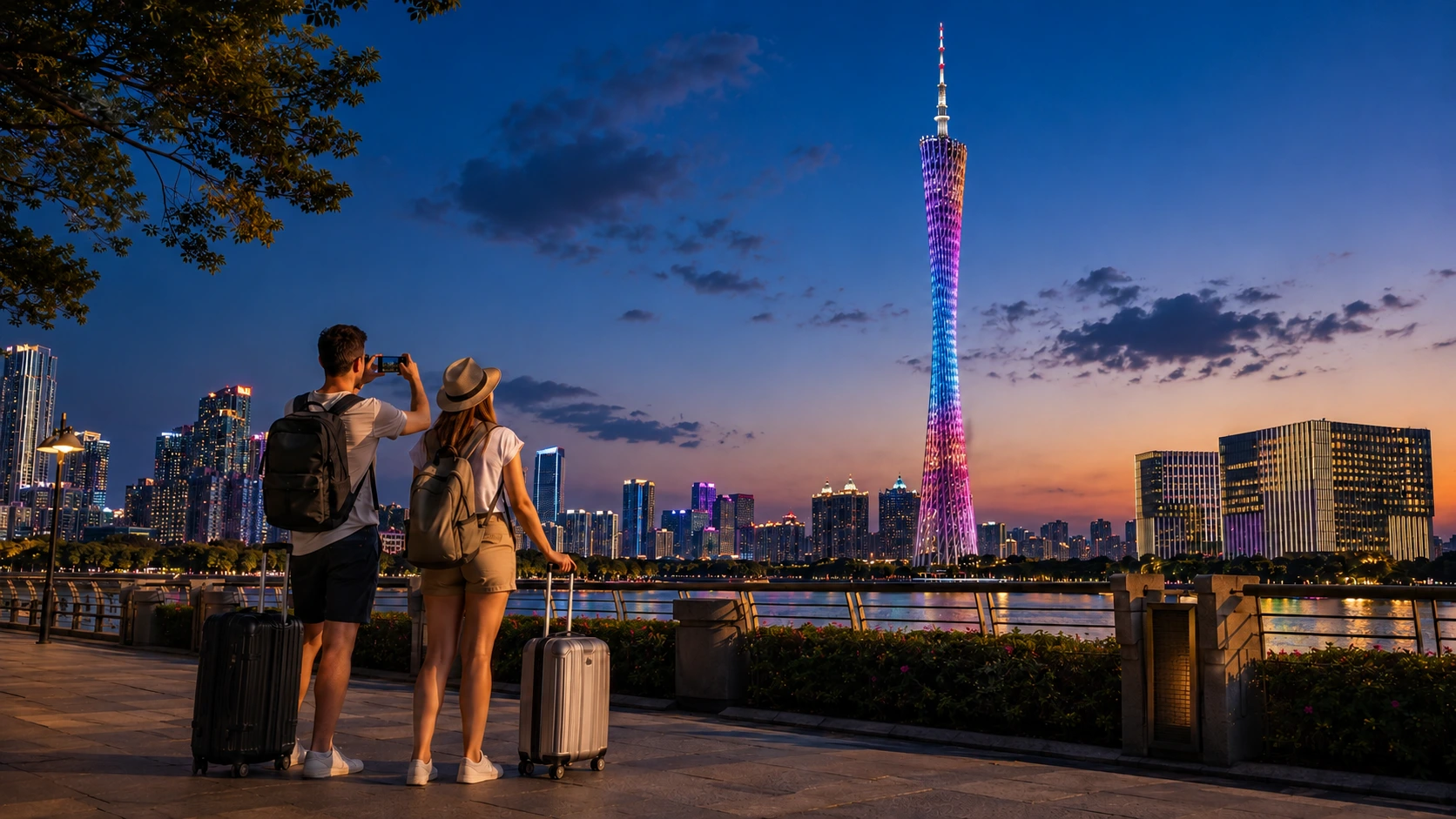
Got a layover in Guangzhou or Shenzhen? Depending on your passport, your route, and how long you're stopping, you may be able to leave the airport and explore the Pearl River Delta without a Chinese visa. That could be a few hours in Guangzhou, a couple of days across Guangzhou and Shenzhen, or a longer trip through Guangdong and beyond.
Which route you use depends on your nationality and trip. Most travelers stopping on the way to a third country use the 240-hour transit policy, which gives up to 10 days and is what this guide mainly covers. A shorter 24-hour visa-free transit is open to almost all nationalities, but it doesn't automatically let you leave the airport: to enter the city you have to ask immigration for a temporary entry permit. And if your country is on the 30-day visa-free list, you don't need to think about transit rules at all: leaving the airport counts as a normal visa-free visit, so you can enter the city without the third-country rule and stay for the length of your layover, up to 30 days.
Below, alongside the entry rules, you'll find a simple Guangzhou and Shenzhen itinerary you can scale to your time. It lists how long it takes to get from the airport into the city and roughly how long each stop takes, with tickets you can book ahead, so even a short half-day out is easy to plan and make the most of.
What the 240-Hour Transit Policy Covers
The 240-hour visa-free transit lets ordinary-passport holders from 57 eligible countries enter China without a visa while traveling on to a third country or region, and stay up to 10 days. It runs through 65 designated ports across 24 provincial-level regions, and Guangzhou and Shenzhen are both covered.
You don't apply ahead of time; you're processed at the port when you arrive. If you're not sure which policy fits your passport, our visa-free countries hub shows it, and the full rules and country list are in our 240-hour transit guide.
If your nationality is on China's 30-day visa-free list, you don't need to worry about the transit rules at all. You don't need an onward ticket to a third country, and the route rule below doesn't apply to you. You simply enter China and stay for as long as your layover lasts, up to 30 days, and explore. For most people on that list, this is the simplest option. The 240-hour transit is the main route for travelers who aren't on the 30-day list, like US passport holders.
The Route Rule That Decides Everything
You need a valid passport and a confirmed onward ticket (or other accepted proof of departure), with set dates and a route to a third country or region. Your onward departure can be by air, rail, ferry, or another permitted international route through an eligible port, not only by plane. The key: the place you arrive from and the place you leave for must be different. Mainland China has to sit between two different countries or regions on your trip.
Routes that work:
- Bangkok → Guangzhou → Hong Kong (Hong Kong can just be a layover, not a real stop): you arrive from Thailand and leave for Hong Kong, a separate region. Qualifies.
- Singapore → Shenzhen → Tokyo (you can fly home to Singapore later): you arrive from Singapore and leave for Japan. Qualifies. The rule only cares that your next stop after China is different from where you came from.
Routes that don't:
- Bangkok → Guangzhou → Bangkok: same country before and after China. Does not qualify.
- Hong Kong → Shenzhen → Hong Kong: same region before and after. Does not qualify.
Hong Kong, Macao, and Taiwan count as separate regions from mainland China here, so flying out to Hong Kong satisfies the rule. The simplest way to unlock the trip: on your way onward, route through a different country or region than the one you flew in from, even just as a layover. You don't have to actually stop there. If your trip is more complicated than "fly in from one place, fly out to another," confirm with your airline before booking that your route still qualifies.
Where You Can Enter
Travelers using the 240-hour transit policy can enter Guangdong through these designated ports:
Airports: Guangzhou Baiyun International Airport (CAN), Shenzhen Bao'an International Airport (SZX), and Jieyang Chaoshan International Airport (SWA).
Rail and passenger ports: Nansha Passenger Port, Shekou Passenger Port, Guangzhou Pazhou Ferry Terminal, Zhongshan Passenger Port, Hengqin Port, the Hong Kong–Zhuhai–Macao Bridge Port, and West Kowloon Station Port of the Guangzhou–Shenzhen–Hong Kong Express Rail Link.
Pazhou Ferry Terminal, Zhongshan Passenger Port, Hengqin Port, the Hong Kong–Zhuhai–Macao Bridge Port, and West Kowloon Station were added on November 5, 2025. West Kowloon Station sits physically in Hong Kong, but its mainland immigration checkpoint operates under the co-location arrangement, so it counts as an eligible port for entering the mainland. Other Guangdong ports may be available for departure, but that doesn't necessarily mean you can use them to obtain 240-hour visa-free entry. Not sure your exact port qualifies? Use the checker below.
When the 240 Hours Start
Your 240-hour window is counted from 00:00 on the day after you enter, not from the moment you land. So arriving in Guangzhou on a Tuesday afternoon, the clock starts at midnight going into Wednesday, which gives you a little extra time on arrival day. Check the exact permitted-stay deadline shown on your temporary entry permit and leave before it expires.
Where You Can Travel
Most travelers spend their layover in Guangzhou or Shenzhen, since that's usually where they land. The permitted stay area, though, covers all of Guangdong Province, so if you've got more than a day to spare, the rest of the Pearl River Delta is open to you too, all on the same visa-free entry. The Delta easily covers:
- Guangzhou — Canton Tower (广州塔), Shamian Island (沙面), the Chen Clan Ancestral Hall (陈家祠), and the riverfront skyline
- Shenzhen — Window of the World, the OCT-LOFT art district, and the Futian business district
- Zhuhai (珠海) — seafront promenades and easy access to Macao
- Foshan (佛山) — ancestral temples, ceramics, and Cantonese culture
You're not necessarily confined to Guangdong. Under the current policy, travelers can move between the officially permitted stay areas in participating regions during the same 240-hour stay. It isn't unrestricted nationwide travel, though: every destination has to be inside a permitted area, and you must exit through an eligible port before your stay expires. For the full list of permitted regions and how the policy works, see our 240-hour transit guide.
And if your country is on the 30-day visa-free list, none of these regional limits apply to you. You can travel almost anywhere in mainland China for the length of your stay, so just plan your trip and go.
One note on Hong Kong and Macao: they're separate regions with their own entry rules, not part of mainland China for this policy. They can be your onward exit. But leaving mainland China for Hong Kong or Macao ends that temporary-entry stay; returning to the mainland would require a new, independently qualifying entry and a fresh decision by immigration.
What to Do on Your Layover
Here's a simple plan for getting out and exploring. If you've only got a few hours, pick one or two things from the top of the list. If you've got a day or two, you can do most of it. Each stop has a rough time next to it, so you can fit it around your flight, and where a place needs a ticket, we've linked it so you can buy ahead and skip the line.
Getting in from the airport. The ride itself is about 50 to 60 minutes from Guangzhou Baiyun (CAN) and about 40 to 50 minutes from Shenzhen Bao'an (SZX), by metro or taxi. But count the whole process, not just the ride. By the time you leave the terminal, collect your luggage, find the metro or the taxi rank, and handle the small stuff like a bathroom, some water, and figuring out the signs for the first time, you're realistically looking at about 1 hour 20 to 1 hour 30 door to door. Build that in so you're never cutting it close for your flight out. The trip back is usually faster, since from the city you can order a taxi to your exact spot and it drops you right at the terminal. Guangzhou and Shenzhen are about 30 to 40 minutes apart by high-speed train, so you can base in one and day-trip to the other.
Don't be shy about asking for help. Keep an offline translator on your phone, and if you get stuck (ordering a car through Alipay or the DiDi app, finding the taxi pickup, or finding where your driver is parked) just show it to any airport staff member or a passer-by. Chinese people are genuinely helpful. Someone will often call your driver, talk to them in Chinese, and point you the right way. It's faster and far less stressful than figuring it out alone, especially when you've only got a few hours in the city. Foreigners in China do this all the time, so don't overthink it.
Day 1 — Guangzhou
Canton Tower (广州塔), about 1.5 to 2 hours. One of the world's tallest observation and broadcasting towers, it twists up into the clouds like a slim spinning top, and from the top you look straight down through a glass floor at the Pearl River far below. There's even an open-air-style observation ride near the top for the brave. Come toward dusk and watch it light up in slow-shifting colour as the whole skyline switches on. Book your tickets in advance, which is sensible on weekends and public holidays.
Shamian Island (沙面), about 1 to 1.5 hours. A tiny island that feels like a slice of old Europe dropped into southern China: cobbled lanes, giant banyan trees, and pastel colonial mansions, with little cafes spilling onto the pavement. It's the calmest, prettiest corner of Guangzhou and an easy place to slow down and take photos. Free to wander.
Chen Clan Ancestral Hall (陈家祠), about 1 hour. A 19th-century courtyard complex where every rooftop drips with carvings of dragons, flowers, and folk-tale scenes, packed so tightly it barely looks real up close. Inside it's now a folk-art museum, and it's one of the most photogenic buildings in the city. An easy metro ride from the centre.
Pearl River night cruise, about 1 hour. After dark the riverbanks erupt in light: Canton Tower, the glowing bridges, and a wall of skyscrapers all mirrored in the water. A slow evening cruise drifts past the whole show, and it's the easiest way to see Guangzhou at its most cinematic. Book your tickets in advance, since popular evening departures can fill on busy dates.
Day 2 — Shenzhen
Take the high-speed train down (about 30 to 40 minutes) for a completely different feel: young, green, and futuristic.
Window of the World, about 2 to 3 hours. Walk from the Eiffel Tower to the pyramids to the Taj Mahal in a single afternoon. It's a whole park of the world's famous landmarks shrunk to size, with shows, rides, and photo ops everywhere. Over the top in the best way, and genuinely fun to wander. Book your tickets in advance, which saves time at the ticket counter.
OCT-LOFT, about 1.5 hours. An old factory zone reborn as Shenzhen's coolest creative district: galleries, indie bookshops, design studios, and specialty coffee, with street art on nearly every wall. The kind of place you wander with no plan and happily lose an hour. Free to explore.
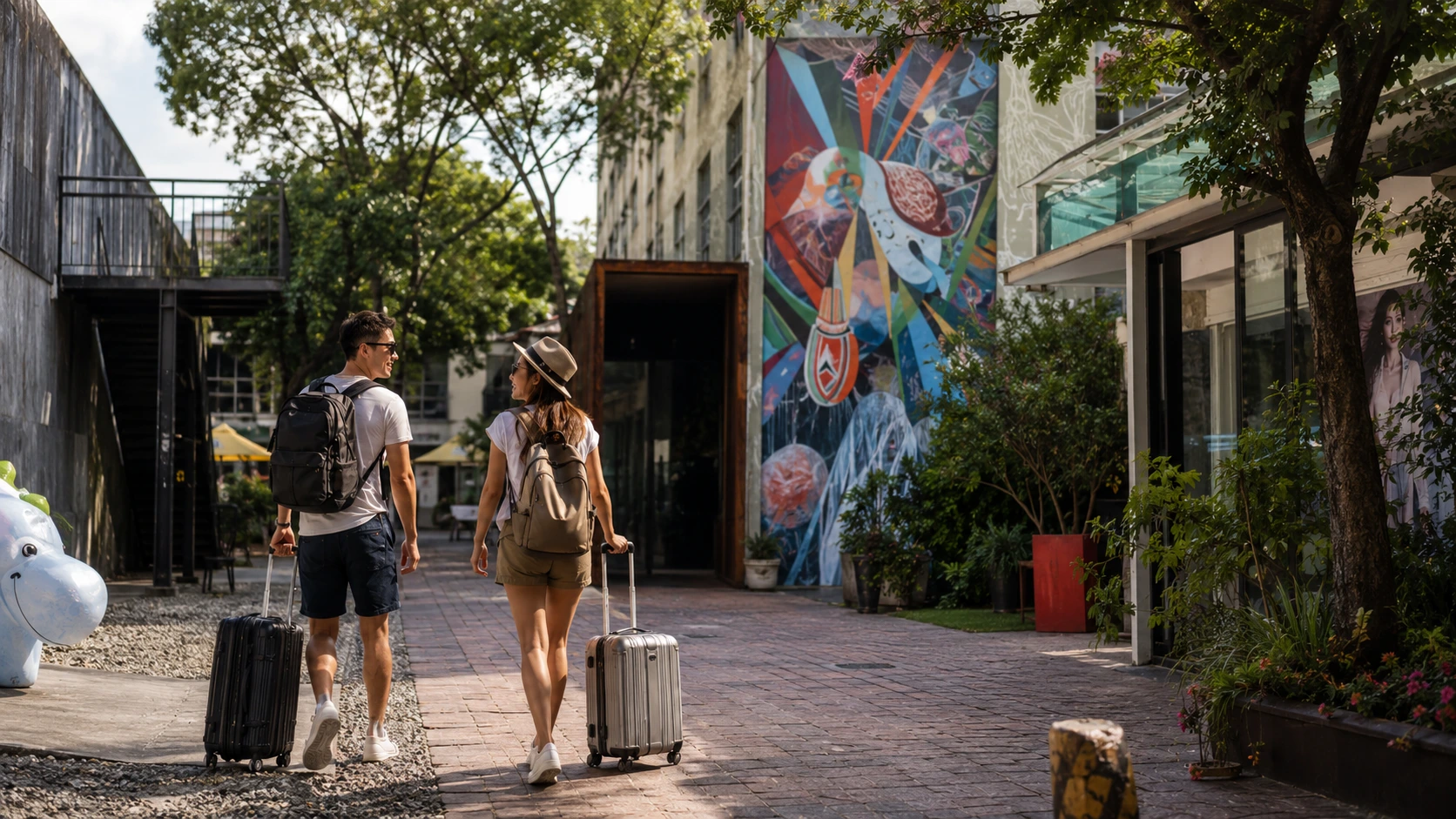
Shenzhen Bay Park, about 1 hour. A long, breezy waterfront where locals jog, fly kites, and gather for the sunset, with the hills of Hong Kong sitting just across the bay. Come late afternoon for the golden light.
Short on time? If you've only got half a day, just pick one main thing to do, like Canton Tower or the Pearl River cruise in Guangzhou, or Window of the World in Shenzhen, and book the ticket before you land so you don't lose time at the counter. You can book most of these on Trip.com and Klook, which list English-language tickets, tours, and airport transfers across Guangzhou and Shenzhen.
What You Can Do — and What You Can't
You can use the time for tourism, business, visits, and exchanges. You can't take paid work, study, or report as a journalist; those need the right visa.
What to Carry at the Border
Have these ready when you arrive at any eligible Guangdong port:
- A valid passport or travel document, valid for at least 3 months
- A confirmed onward ticket to a third country or region, departing within your 240-hour window
- The Arrival Card for foreigners — you can fill it in online before you fly, or complete a paper card at the port
- Your hotel booking or accommodation address in China, in case the officer asks
When immigration asks why you're entering, tell them you're using the 240-hour visa-free transit policy, so they apply the right rules. You don't apply in advance, but meeting the conditions doesn't automatically guarantee entry. Final approval is always made by the immigration inspection officers at the port.
How It Compares to China's Other Visa-Free Options
| Policy | Onward ticket to a third country? | Can China be your destination? | Max stay |
|---|---|---|---|
| 240-hour transit (this article) | Yes — required | No | Up to 10 days |
| 30-day visa-free | No | Yes | Up to 30 days |
| Mutual visa exemption | No | Yes | Varies by agreement |
If you hold an ordinary passport from a country on the 30-day visa-free list, that's usually simpler. The transit policy is for travelers who don't qualify for one of those, or who genuinely are just passing through. For a full breakdown by nationality, see our China visa-free countries hub.
Getting Ready for the Trip
Once your tickets are sorted, set a few things up before you land. You'll want a China eSIM for data the moment you arrive, a VPN installed before you go so you can still use apps like Google, WhatsApp, and Instagram inside the mainland, and WeChat and Alipay on your phone so you can pay the way locals do. You can book your flights and Guangdong hotels on Trip.com, which has strong mainland coverage and plenty of refundable options. Our first-China-trip guide shows you how to set all of it up.
Want everything in one place? We've put it into a single downloadable guide that covers entry rules, apps, payments, and getting around, with screenshots, plus our own checked picks for places to eat and visit across a number of cities.
FAQ
Can US citizens use this policy in Guangzhou or Shenzhen?
Yes. US citizens are eligible for the 240-hour visa-free transit policy. You need a confirmed onward ticket to a third country or region within 240 hours, and you must enter through an eligible port and meet the other conditions. Final approval is always made by immigration inspection authorities at the port.
How long can I stay?
Up to 240 hours, which is 10 days. The clock starts at 00:00 on the day after you arrive, so your arrival day is essentially a bonus.
Do I need an onward ticket?
Yes. You need a confirmed ticket, with a fixed date, to a third country or region, leaving China within 240 hours of entry. The place you fly out to must be different from the place you arrived from.
Can I fly from Hong Kong to Guangzhou and back to Hong Kong?
No. You must arrive from one country or region and leave for a different one. Hong Kong → Guangzhou → Bangkok works; Hong Kong → Guangzhou → Hong Kong does not, because Hong Kong is both your arrival and departure region.
Can I take the high-speed train from Hong Kong into Guangzhou?
Yes. In November 2025 the West Kowloon Station of the Guangzhou-Shenzhen-Hong Kong Express Rail Link became an eligible port, so you can enter mainland China from Hong Kong by high-speed train using the 240-hour transit policy, as long as the other conditions are met.
Can I visit other Chinese cities outside Guangdong?
Yes, within limits. The transit policy lets you move between the officially permitted stay areas in the participating regions, so you're not confined to Guangdong. It isn't unrestricted nationwide travel, though: every destination has to be inside a permitted area, and you must exit through an eligible port within your 240 hours. Most layover travelers just stay around the Pearl River Delta, where there's plenty to do.
Can I go to Hong Kong or Macao while on this policy?
Hong Kong and Macao are separate regions with their own entry rules. They can be your onward exit. But leaving the mainland for Hong Kong or Macao ends that temporary-entry stay; coming back to the mainland would need a new, independently qualifying entry and a fresh decision by immigration.
What if I've used the 240-hour policy before?
You can use it again on a separate qualifying trip, as long as each trip independently meets the route, document, port, timing, and permitted-area requirements. Official guidance doesn't state a cumulative annual limit, but final approval is always made by immigration authorities at the port.
Where do I book tours and activities in Guangzhou and Shenzhen?
The two platforms most travelers use are Trip.com and Klook. Both list English-language tours, Canton Tower tickets, theme parks, food tours, and airport transfers across Guangzhou, Shenzhen, and the rest of Guangdong.
Sources
- National Immigration Administration — Visa-Free Transit Policies
- National Immigration Administration — 10 New Immigration Measures (5 new Guangdong ports, Nov 2025)
- National Immigration Administration — Visa-Free Transit Fully Relaxed and Optimized (cross-province travel)
- State Council — China Widens Visa-Free Access (Nov 2025)
Bottom Line
Guangzhou and Shenzhen are both covered by China's 240-hour visa-free transit, which gives travelers from 57 eligible countries up to 10 days with no visa. The one firm rule is that mainland China must sit between two different countries or regions on your trip, like Bangkok → Guangzhou → Hong Kong or Singapore → Shenzhen → Tokyo. You can enter through Guangzhou Baiyun, Shenzhen Bao'an, or, since November 2025, overland from Hong Kong and Macao through the bridge or the West Kowloon high-speed rail. The Pearl River Delta is a natural base, and you can travel further across the permitted areas in the other regions if your itinerary allows. Bring your valid passport and confirmed onward ticket, and remember that final approval is always made by immigration inspection authorities at the port. For route-specific questions before booking, contact the China Immigration Service Hotline 12367.