
Last updated: August 20, 2026 Some links are affiliate links, see our Affiliate Disclosure.
Hangzhou Visa-Free Travel Guide: West Lake and What to See
Seven hundred years ago Marco Polo came to Hangzhou and called it the finest city in the world.
He was looking at a lake with hills around it, temples in the trees, and stone bridges arching over the water. All of that is still there, in the middle of a modern city of twelve million people.
The fastest train from Shanghai takes 34 minutes. From Suzhou it's about an hour.
That's why most people see all three cities in one trip. They come to Shanghai first, then add a day or two in Hangzhou and a day in Suzhou.
The three cities are close to each other, and trains run between them all day.
This guide is for everyone, with a visa or without one. And because visa-free travel is what we write about every day, we will also explain which visa-free policies let you travel to Hangzhou.
Hangzhou Is Open to Everyone
Some visa-free policies limit which parts of China you're allowed to travel in. Hangzhou is not affected by those limits.
You can travel to Hangzhou on China's nationwide 30-day visa-free policy if your passport is eligible, on an applicable mutual visa-exemption agreement, and on the 240-hour visa-free transit policy. Zhejiang, the province Hangzhou is in, is inside the permitted area for 240-hour transit travellers. If you're coming on a tourist visa, you can go as well.
One thing to know. China also has regional visa-free routes, and those can limit where you are allowed to go. The Hainan visa-free policy is the clearest example: it lets you in without a visa, but you have to stay in Hainan. So check which policy you are actually using before you plan a trip.
Not sure which one applies to you? Check our eligibility checker.
West Lake
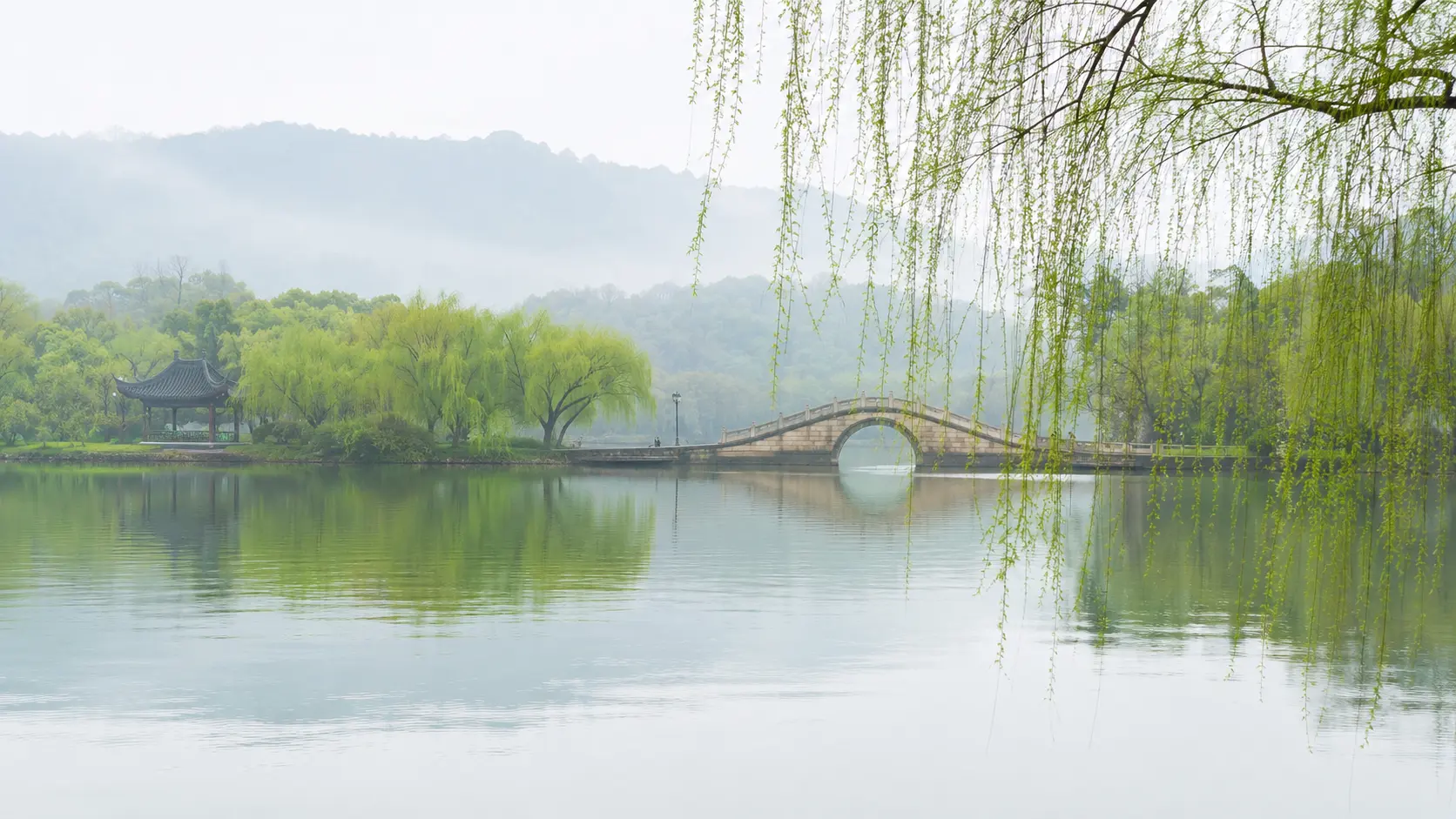
West Lake is the reason many people come to Hangzhou.
The lake is in the middle of the city. There are green hills behind it on three sides. On foggy mornings the tops of the hills vanish into the white, and that's when the lake looks its best.
The lake is quite large. The full loop is around 15 kilometres. There's a shorter route, but even that takes about three to four hours. Most visitors therefore walk a section along the waterfront, then continue by boat or taxi.
Willow trees hang over the water. Old stone bridges cross it, and each one is high in the middle so boats can pass under.
Painters and poets have been writing about West Lake for more than a thousand years, and its scenery has inspired gardens across China, Japan, and Korea. Picture a classic Chinese landscape painting: misty water, a small bridge, and hazy hills in the distance. West Lake is very close to that image.
It's free, and it never closes. No ticket, no gate, no opening hours. Come at six in the morning when the mist is still on the water, and the only other people around are the older locals doing their morning exercise.
Two long paths cross the lake. They are not bridges. They are strips of land with trees on both sides. When you walk along one, there is water on your left and water on your right.
Su Causeway is the long one. It takes about an hour to walk.
It is made of mud. A thousand years ago the lake was filling up with mud, so the city dug it out. The man in charge was a famous poet called Su Shi. Instead of throwing the mud away, he had it piled up in a long line across the water. It dried out and became this path.
Bai Causeway is the short one. It is named after another famous poet, Bai Juyi, but he did not build it. He built something else here, and that one is long gone. This path was already here. People named it after him later.
Start at Broken Bridge, where Bai Causeway meets the shore. It's a small stone bridge and it's the most famous spot on the lake.
The name is a trick. The bridge isn't broken. But when snow settles on it and begins to melt, the sunny side clears while the shaded side stays white, and from across the water the middle of the bridge looks like it has gone. People have been coming to see that for hundreds of years.
There is a second reason this bridge is famous, and it's a love story. We'll talk about it more later.
What you see depends on when you come. In spring the paths are lined with peach and cherry blossom. In summer the lake fills with lotus flowers, thousands of them. In fall there are fewer people and the leaves turn gold. Winter is cold, clear and quiet.
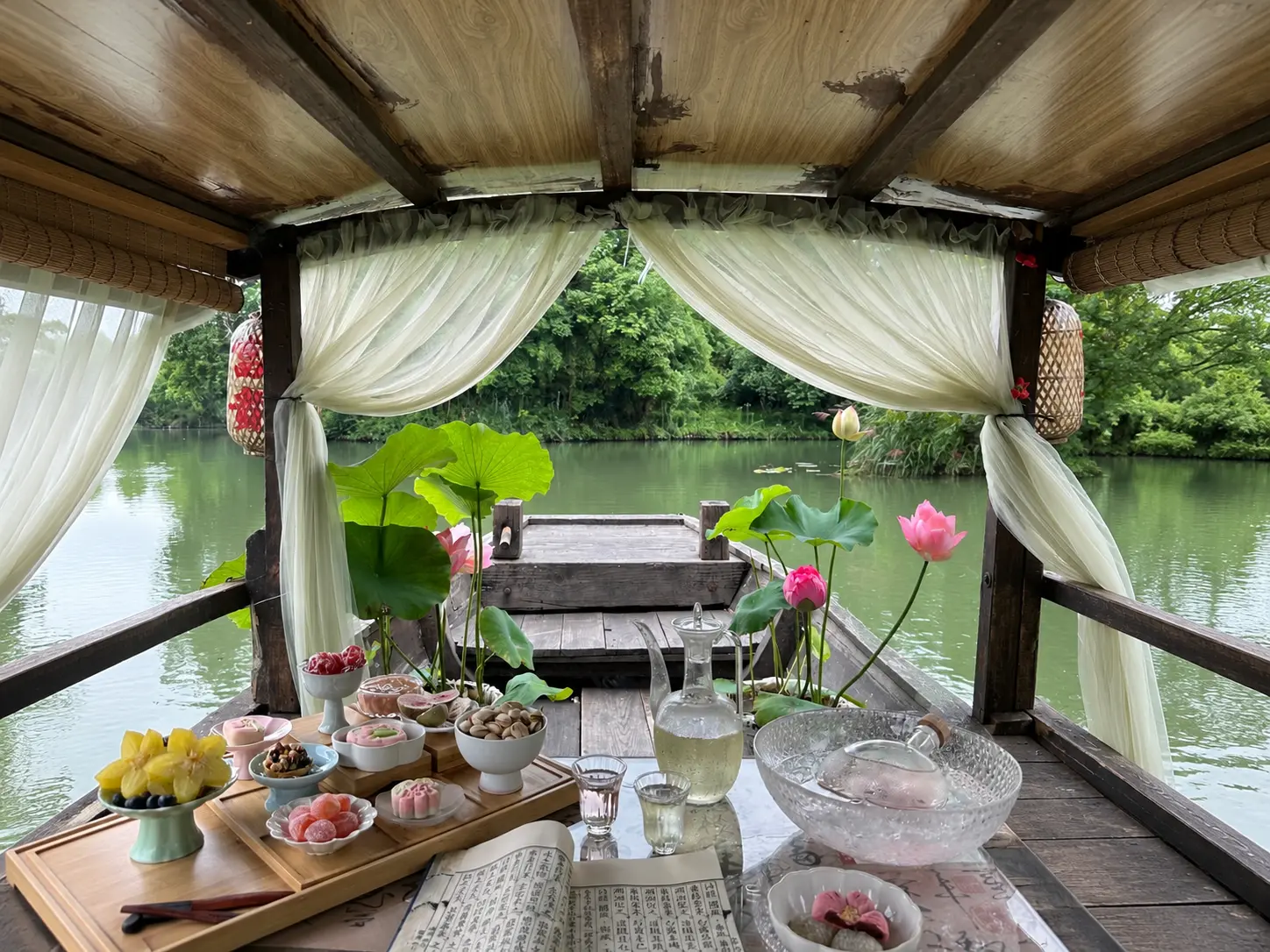
Get a boat. There are two kinds on West Lake.
The small wooden ones are rowed by hand. They move slowly and they sit low, so the water is right next to you.
The bigger ones are faster and have a roof over the top.
Both of them stop at the islands in the middle. Island boat tickets are generally 55 to 70 yuan (about $8 to $10) depending on the type of boat, and that includes stops on the islands.
If you would rather have someone explain what you are looking at, Trip.com offers half-day tours in English that include both the Leifeng Pagoda visit and the boat ride. They take about three hours.
There are many reviews for every tour and attraction on Trip.com, so you can read what real visitors said before you book.
There are three small stone towers standing in the water next to the main island. Each one has round holes cut in the sides. On the night of the fall moon festival, people put candles inside them. The light comes out through the holes and looks like small moons on the water.
Qingshan Lake Water Forest
This is the most unusual place near Hangzhou. And few foreign visitors know about it.
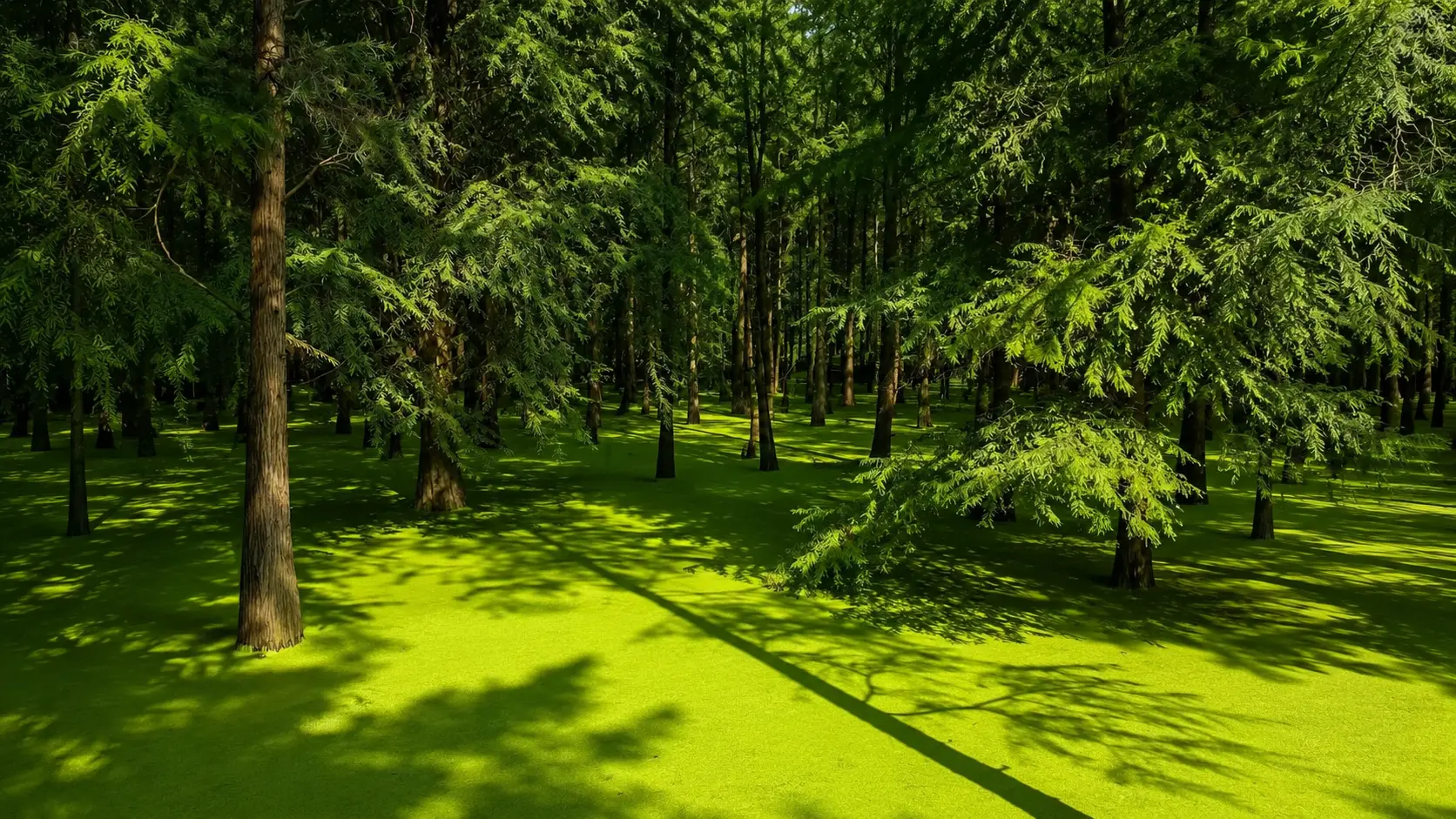
About an hour from the city there is a lake with a forest in it. The trees are standing in the water. So it looks like the whole forest is growing in the middle of the lake.
Thousands of them, tall and thin. Narrow wooden bridges between the trees let you walk right through it.
Most trees die if their roots are under water. These ones do not. They are cypress trees, and to breathe they push small woody bumps up out of the water around each trunk. They look like little knees. The water is full of them.
In spring and summer everything is green. Light comes through the leaves and turns the water green too. Chinese visitors call it the matcha lake, after the green tea powder.
Then in late November and December the leaves turn red and orange, and the place looks completely different.
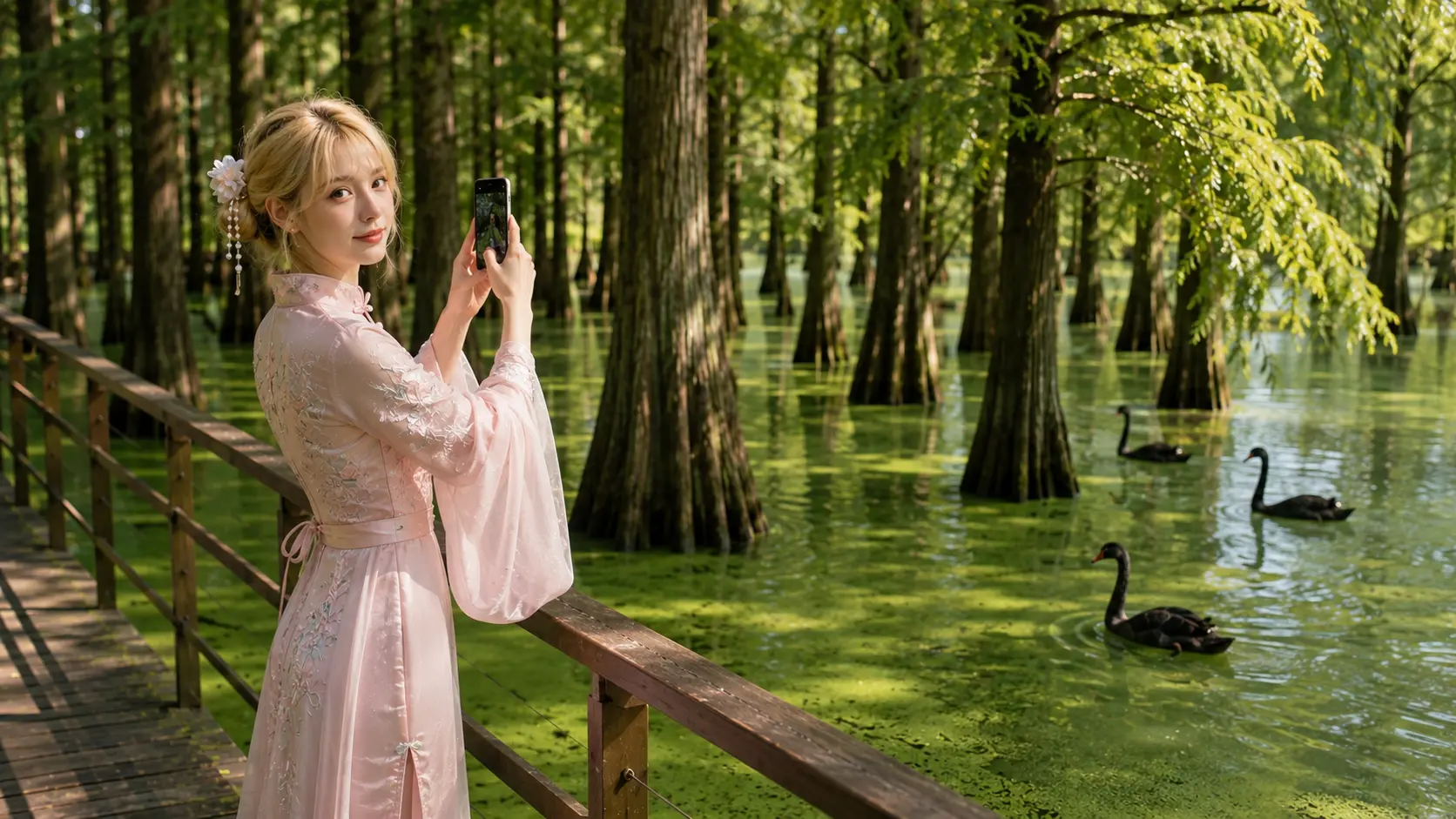
There are animals here too. Deer wander around freely in the camping area, just to the right of the entrance. And sometimes you can see ducks and black swans out on the water.
Tickets cost 40 yuan (about $6). The path around the outside of the lake is free, if you only want the walk.
Getting there. Take Metro Line 16 to Qingshanhu station or Babaili station, then walk for 10 to 15 minutes.
It is about 38 kilometres from the city centre, so it will probably take about an hour or a little more, one way.
If you take a taxi, order it to the water forest ticket office, or ask the driver to stop there. The park has many entrances, and this one is the closest to the lake with the trees.
Two to three hours is enough to slowly walk around and enjoy the nature.
Three small things. A cloudy day is better than a sunny one, because strong sunlight washes the green out. The wooden walkway near the exit is where everybody takes their photo, pointing the camera down at the water. And you can rent a kayak and paddle in among the trees, 120 yuan (about $17) for one person or 220 yuan (about $31) for two.
Leifeng Pagoda and the White Snake
There is a hill near the lake with a pagoda on top of it.
A pagoda is a tall tower with many floors. Each floor has its own curved roof, and each one is a little smaller than the one below, so the whole thing narrows as it goes up. This one has five floors, and you can go inside and climb it.
From the top you get the best view of West Lake. The whole lake, and the city behind it.
But that is not why Chinese visitors come here. They come for the story.
The story. A white snake with magic powers turned herself into a woman. One rainy day she met a young man on Broken Bridge, at the other end of the lake, and he shared his umbrella with her. They fell in love and got married.
A monk decided this was wrong. He pulled the two of them apart and trapped her under this pagoda. She stayed down there for hundreds of years.
Everyone in China knows this story. It is one of the four great folk tales of the country, and there are films, TV shows and operas about it.
It is also why people stand on Broken Bridge. That is where the two of them met.
Then in 1924 the pagoda fell down. People joked that the snake had finally got out.
The one you climb today was built in 2002. The broken remains of the old one are still underneath it, with glass over the top so you can look down at them.
Tickets are 40 yuan (about $6). Go up near sunset.
Yue Fei Temple
By the lake there is a temple built for a general called Yue Fei.
Eight hundred years ago he defended China in a war. Then officials at court who wanted him gone accused him of crimes he did not commit, and he was killed. Chinese people have never forgotten it.
Inside the temple, in front of his tomb, four iron statues kneel with their hands tied behind their backs. They are the people who framed him. For hundreds of years visitors spat on them, and there is now a sign asking people not to.
The Quiet Side of the Lake
The hills on the far side of the lake are where people who live in Hangzhou go. Most visitors never get there, because they stay near the city side, where the crowds are.
There is more up in those hills than you would expect.
Hupao and the water
Hupao is a park in a valley, about fifteen minutes from the lake. Old trees, small streams, a little temple, and a spring.
The spring is the reason to come. A spring is water that comes up out of the ground on its own, clean enough to drink.
Hangzhou has a saying about its two best things: the water from Hupao and the tea from Longjing. Four hundred years ago a writer put it simply. Of all the springs around West Lake, Hupao is the best. Of all the teas grown in these hills, Longjing is the finest.
Make one with the other and the tea tastes different. People here really believe it.
Come early and you will see older men and women filling big plastic bottles at the spring to carry home. They do this every week.
Tickets are 15 yuan (about $2). Eight in the morning is the best time. It is empty and cool, and the light coming down through the trees makes the whole place look magical.
Manjuelong
Five minutes from Hupao, a road goes up into the hills. Osmanthus trees grow along both sides of it. There are more than seven thousand, and some of them are two hundred years old.
Osmanthus is a tree with tiny yellow flowers. You can barely see them, but they smell very sweet.
For about three weeks in the fall, all the trees flower at the same time. The whole road smells sweet.
People have been coming here every fall for the past six hundred years to see this. It is on the official list of the ten best sights around West Lake. Many visitors just sit under the trees and drink tea all day.
A small path goes from the road up to the top of the hill. From there you can see the whole of West Lake below you.
Where to end the day
Jixian Pavilion stands out on the water on the east shore, by Lakeside Park. A pavilion is a small building with a roof and open sides, made for sitting in and looking out.
This is where people come for the sunset. In summer the lotus leaves grow right up to it. Come here around 6pm or 6:30pm.
There are two more places to stop on the way.
Xiaoxia Nong is a narrow old street. The houses along it are low, with grey roofs. Stand on the steps in the middle and look ahead, and you will see a pagoda rising above the roofs.
Keep walking and the street takes you to Wushan Square, where there is a flower market. In summer they sell lotus flowers, tied in bunches and wrapped in paper. Most of the people buying them live here.
Lingyin Temple
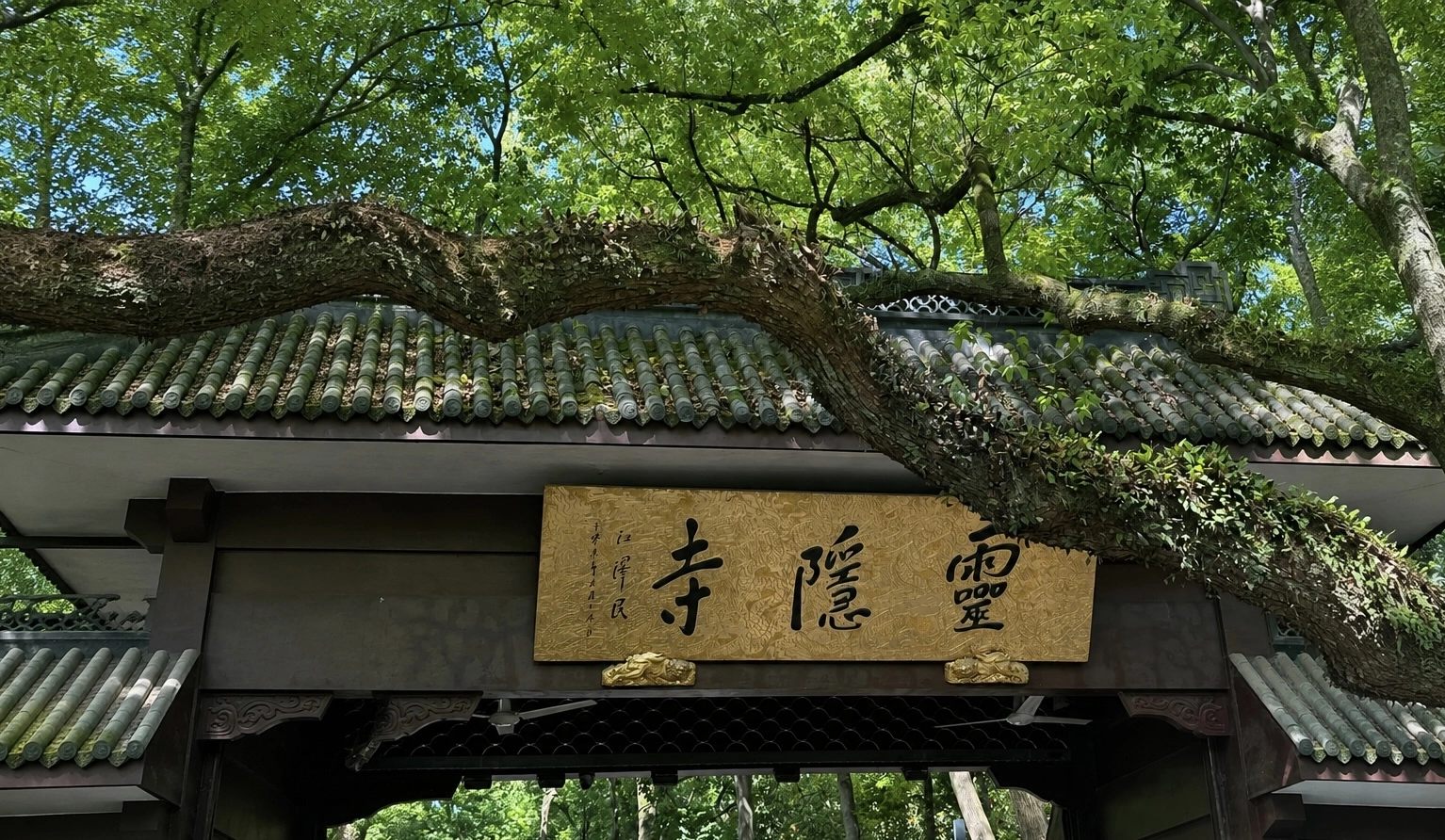
This is one of the biggest and oldest Buddhist temples in China. It was built in the year 328, in a valley full of trees.
Monks still live there today. They spend their days praying, the same way monks have done here for almost 1,700 years.
The first thing you notice is the smell. People burn thin sticks called incense. They burn slowly and make sweet smoke, and the smoke hangs in the air around the buildings.
Inside the main hall is a statue of Buddha. It is almost twenty metres tall, about as high as a six-floor building. It is made of wood and covered in a thin layer of gold.
Most people who come here are not coming just to see the temple. They come to pray.
Next to the temple is a hill called Feilai Feng. The name means "the hill that flew here". An old story says it flew all the way from India.
Hundreds of small Buddha statues are cut into the rock of this hill, and into the caves inside it. The oldest ones are about a thousand years old. Trees have grown over many of them, so you keep finding them by surprise as you walk.
Now read this part carefully. It changed recently.
The temples are free. Lingyin, Yongfu and Taoguang. You pay nothing.
But you must book a time before you go, and the rules are strict.
Book at least one day early. You do this inside Alipay or WeChat. Open the small app inside them called 杭州灵隐飞来峰. You can book up to seven days early. You cannot book on the same day.
If your day is full, there is a waiting list in the same app. Until February 2026 you could sign up at a desk outside. That desk is gone now. So book early.
You need the name and passport number of everyone going. You can book for up to five people from one account. Bring the passport itself, because they check it at the gate.
If you book a time and then you cannot come, you must cancel before 5pm the day before. If you do not cancel, you cannot book again for 30 days.
There are two times: morning, 7:30 to 12:00, and afternoon, 12:00 to 17:00. The last group goes in at 17:00.
The mini app you book through is in Chinese. But WeChat can translate it. Open the app, tap the three dots in the top right corner, and choose Translate. The whole page turns into English.
Or just ask your hotel to book it for you.
This is how it worked in August 2026. The rules changed twice in the past year, so check before you travel.
Longjing Tea Village
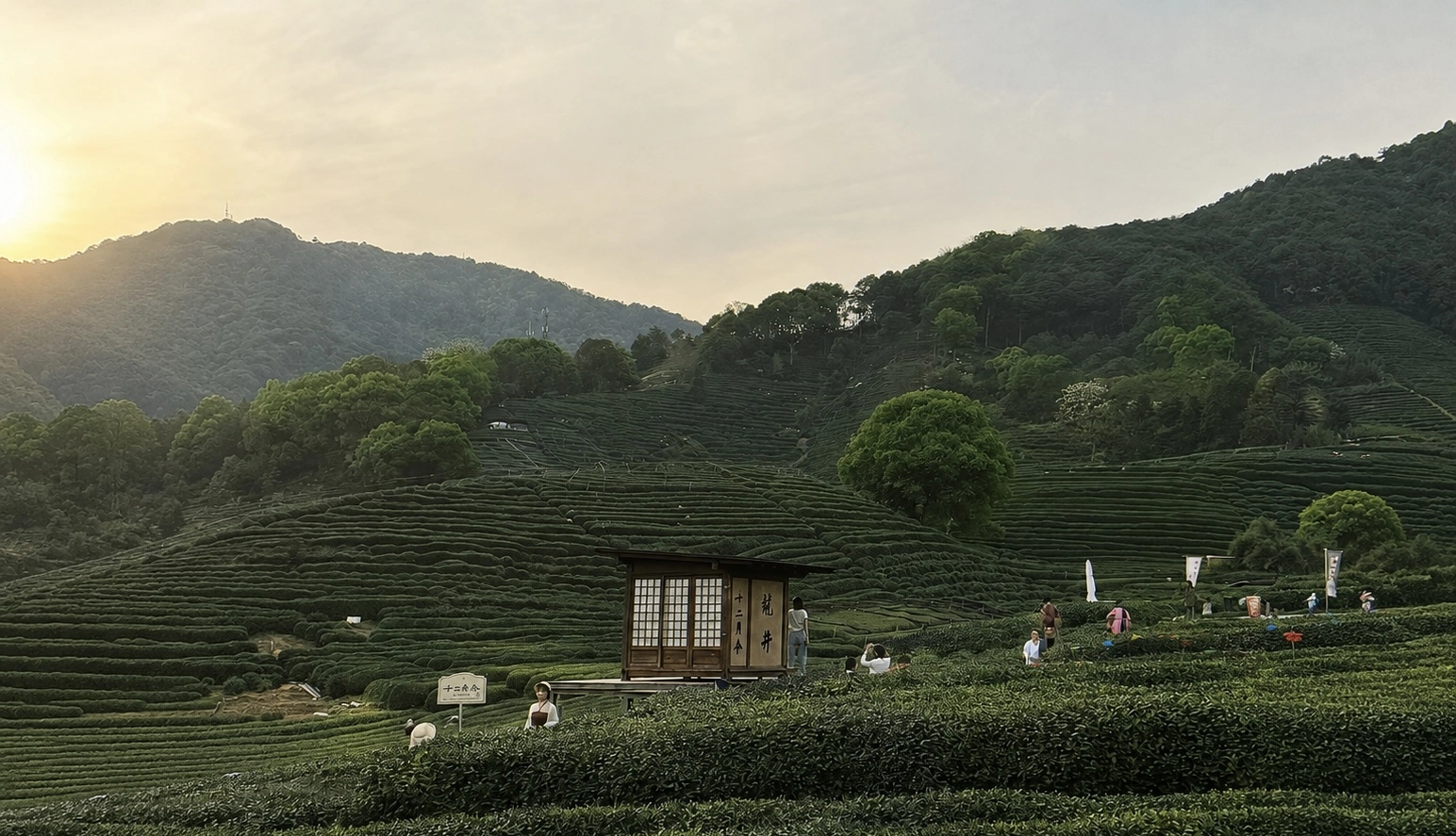
Just about twenty minutes from the city centre there are tea villages up in the mountains.
The tea is called Longjing. The name means Dragon Well. It is one of the most famous green teas in China.
The tea plants grow in long rows. The rows follow the shape of the mountain, going up and down and around it.
Here is how they turn those leaves into tea.
The picked leaves go into a big round metal pan. The pan is about 200 degrees Celsius, which is hotter than an oven. Far too hot to touch. But the worker still uses bare hands. They press the leaves against the hot metal and turn them again and again, until the leaves are dry and flat. It takes years to learn.
You can walk into a tea house in one of the villages and watch someone do it, right in front of you.
You can also have a very unique experience. A person who has worked in these tea fields for years takes you out there and shows you how to pick the leaves. Then you do it yourself. After that they teach you how to dry them.
Some of these sessions come with an English-speaking guide. You can book the experience here.
The best tea of the year is picked in March. There is a spring holiday in early April called Qingming. Tea picked before that day is the most expensive, and it has its own name: Mingqian tea. Tea picked after that day costs much less, and it is still very good.
Most places will pour you a cup to try. You do not have to buy anything. But be ready, because real Longjing tea is expensive everywhere, even here where it grows.
The Longjing tea villages are just ten minutes from Hupao.
Xixi Wetland
A wetland is ground that is always wet. Part land, part water, and hard to tell where one stops and the other starts.
Xixi is a big wetland park. Inside it there are hundreds of small narrow rivers. Tall grass grows on both sides of the water. It is called reed, and it can grow taller than a person.
You can travel around it in a wooden boat. A man stands at the back and pushes it along with a long oar. The rivers are narrow, so the reeds brush against the sides of the boat as you pass.
A boat is not required. There are paths and wooden bridges everywhere in the park, so you can walk instead.
Tickets cost 80 yuan (about $11) for adults. Visitors aged 60 to 69 pay 40 yuan, and anyone 70 or over goes free. Some parts of the park are free. Boats cost extra.
Getting there. Take Metro Line 3 to Xixi Wetland South station. Or take a taxi from the city centre, which takes about half an hour depending on traffic.
The Giant Wave on the Qiantang River
In Hangzhou there is a big river called the Qiantang. Something happens there that happens almost nowhere else in the world.
First, how the sea works. Twice a day the sea rises and falls. This is called the tide. In most places the water rises slowly and you barely notice it.
Here it is different. Where this river meets the sea it is very wide. Then it gets narrower and narrower as it goes inland.
So when the tide comes in, a huge amount of sea water is pushed into a space that keeps getting smaller. The water has nowhere to go. It climbs on top of itself until it becomes a wall of water, and that wall runs up the river the wrong way.
You hear it before you see it.
In English this is called a tidal bore.
When does it happen? Chinese dates follow the moon, not the normal calendar. One lunar month is one full cycle of the moon, about 29 days.
The best times to see it are roughly the 1st to 5th and the 15th to 20th day of each lunar month. The tide itself comes in twice a day, every day. What changes is whether a big, clearly visible wave forms, and how large it gets. Weather, how much water is coming down the river, and the shape of the riverbed all make a difference.
The most famous viewing period of the year is around the 18th day of the 8th lunar month, when the wave is traditionally at its strongest. In 2026 that falls on 28 September. People have been coming to watch it for more than a thousand years.
Where to stand. The best place is Yanguan, in Haining, about an hour from Hangzhou. There the wave arrives as one straight line stretching all the way across the river. That is why it is called the "one-line tide".
Get there at least 40 minutes early. The time changes a little every day, and you will want a good spot.
Stay behind the fences. The wave is much stronger than it looks. People get hurt by it almost every year.
Hefang Street and What to Eat
Hefang Street is an old street in the middle of the city with no cars on it. Small wooden shops line both sides, selling tea, silk, snacks, medicine and handmade things.
It is full of tourists. It is also the easiest place to try Hangzhou food, because you can find a lot of it in one place.
At night the red lanterns turn on, and the whole street is glowing.
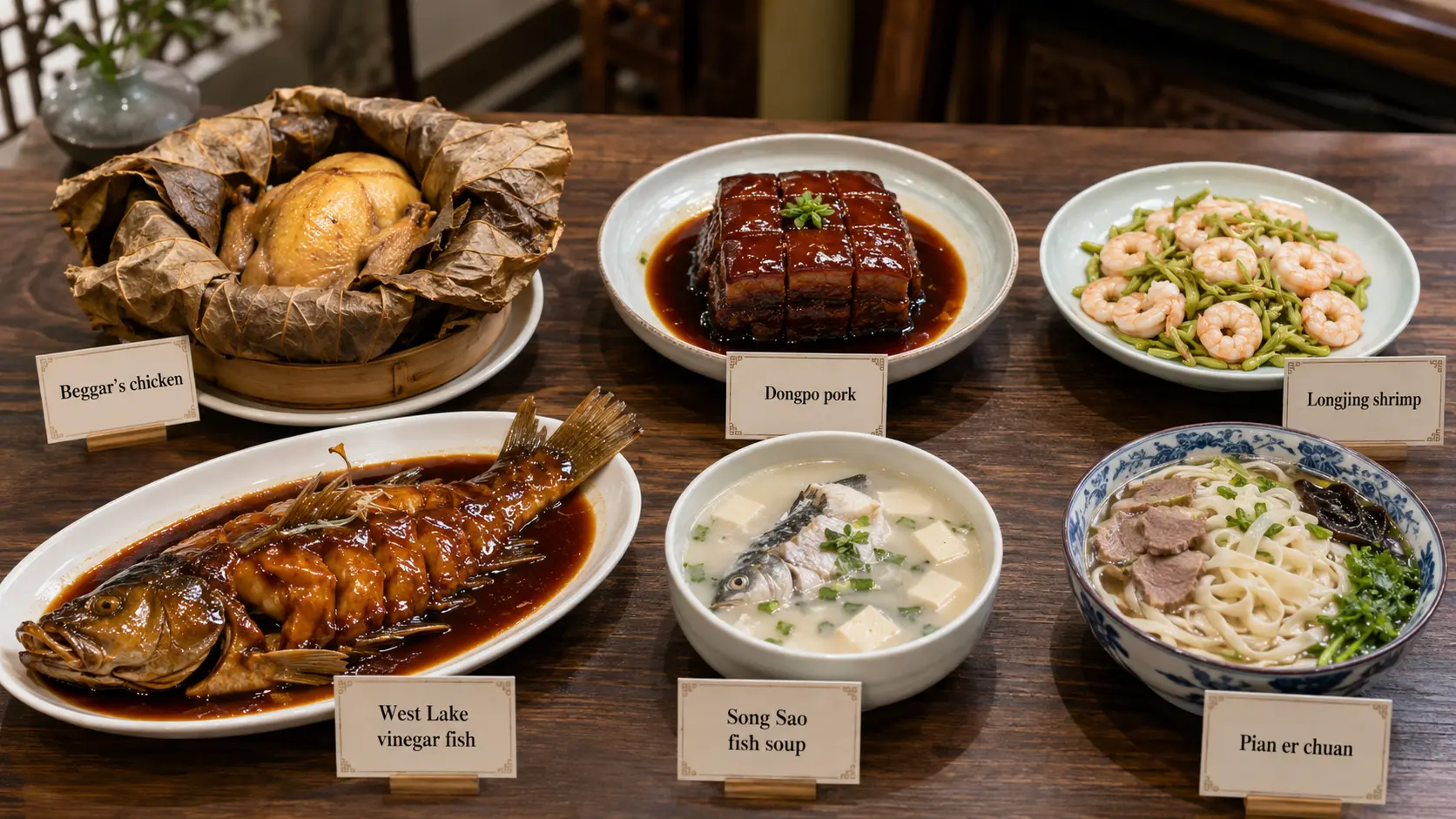
Order these in a restaurant.
Beggar's chicken. A whole chicken is filled with meat and vegetables, wrapped in big lotus leaves, then covered in wet clay and baked until the clay turns hard. It arrives at your table looking like a lump of rock. Someone cracks it open in front of you. The old story says a beggar stole a chicken and had to hide it in mud to cook it.
Dongpo pork. Squares of pork belly cooked very slowly in wine and soy sauce. They come out dark and shiny and so soft you can eat them with a spoon. They are named after a poet who once ran this city, and the story says he invented the dish.
Longjing shrimp. Small river shrimp cooked quickly in a hot pan with fresh tea leaves and a little tea. The leaves stay in the dish and you eat them too. It tastes green and grassy, which is not what you expect from shrimp.
West Lake vinegar fish. A whole fish cooked in water and served under a sweet and sour sauce. Everyone here orders it, and everyone has an opinion about it.
Song Sao fish soup. A thick soup, a little sour and a little peppery, with small pieces of fish through it. The story says a woman cooked it for a Chinese emperor eight hundred years ago.
Pian er chuan. If you only eat one thing here, eat this. It is the normal everyday noodle bowl of Hangzhou: noodles in hot soup with salted vegetables, soft young bamboo and slices of pork. People eat it for breakfast and for lunch, and they argue about which shop makes it best.
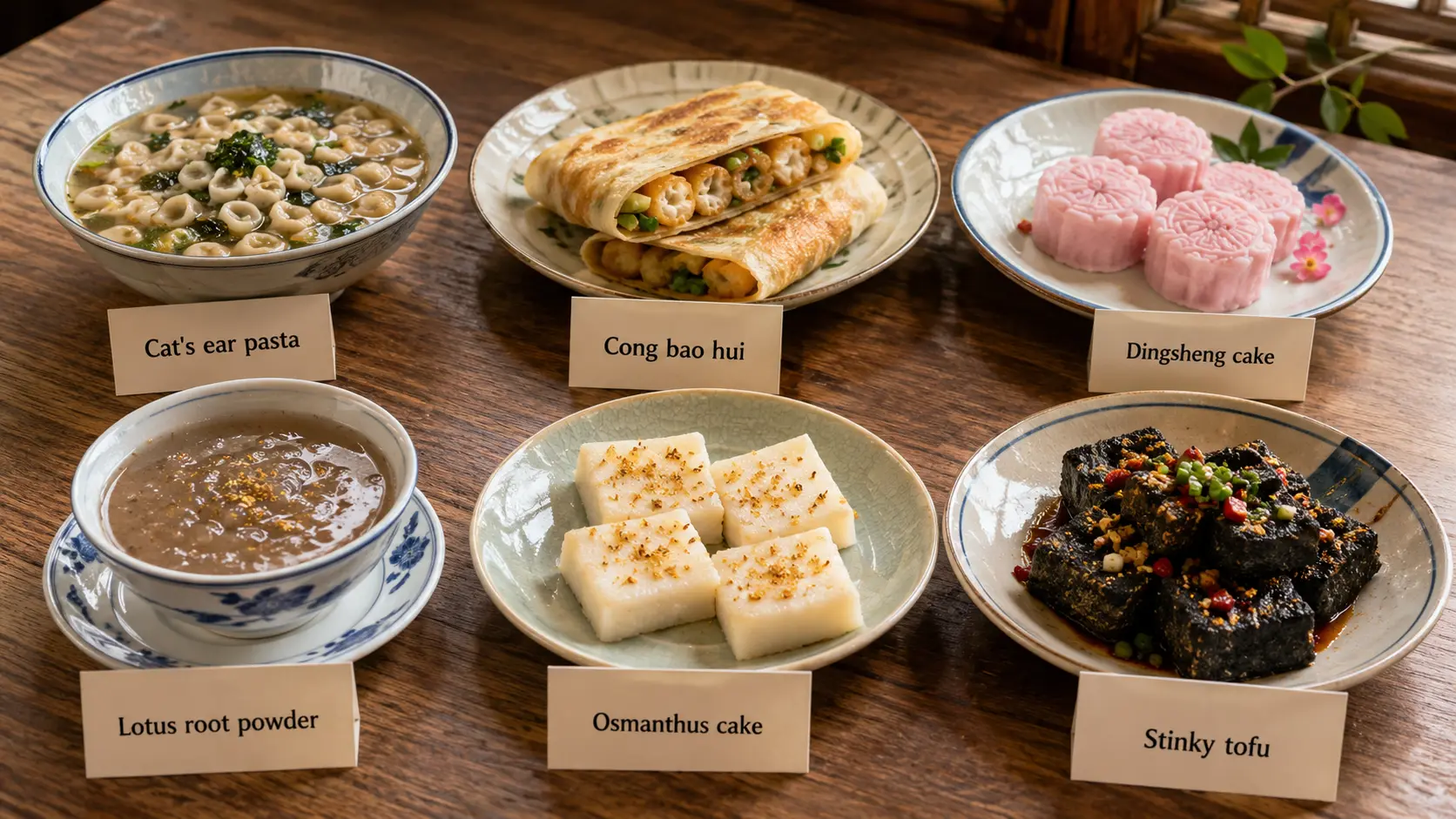
And these you can buy on the street while you walk.
- Cat's ear pasta. Small curled pieces of dough in soup, each one about the size of your fingernail. They are named after the shape.
- Cong bao hui. A thin pancake wrapped around a spring onion and a stick of fried dough, then pressed flat on a hot plate until it goes crispy.
- Dingsheng cake. A soft pink cake made of rice. Soldiers were given these before a battle for good luck, and students still buy them before exams.
- Lotus root powder. You stir it into hot water and it turns into a warm, clear, slightly sweet jelly. Strange the first time. Then you want more.
- Osmanthus cake. Soft and sweet, made with those tiny yellow flowers from the mountain road.
- Stinky tofu. You will smell it long before you see it. It tastes much better than it smells.
The Grand Canal
A canal is a river that people dug themselves.
The Beijing to Hangzhou Grand Canal is the longest and oldest one ever dug by hand anywhere in the world. It runs for about 1,800 kilometres, all the way from Hangzhou to Beijing.
Its oldest sections were dug more than 2,500 years ago. The great connected canal system, the one that joined everything into a single route, took shape about 1,400 years ago.
It was dug so that boats could carry rice and other goods from the warm part of China where the food grows, to the colder part where the emperors lived.
Hangzhou is where the canal ends.
You can walk along it here, near Gongchen Bridge. It is a tall stone bridge that curves up high in the middle so boats could pass underneath. The first one was built in 1631. It fell down and was rebuilt several times, and the one standing today comes from a rebuild in the 1880s, so it is about 140 years old.
At night there are boats that go along a lit part of the canal.
If you want to know how it was all dug, there is a museum next to the bridge.
Give it half a day. If your time is short, skip it and stay by the lake.
Getting to Hangzhou from Shanghai
The fastest train takes 34 minutes. Most take 45 minutes to an hour.
There are hundreds of trains every day, from early in the morning until late at night. The earliest train leaves around 6am and the last one around 10:30pm.
These times change with the season and with how busy the railway is, so treat them as a rough guide and check the real times when you book.
The stations. Shanghai has two main stations with trains to Hangzhou: Shanghai Hongqiao and Shanghai South. Both have many trains every day.
In Hangzhou the biggest station is Hangzhou East. If you are coming as a tourist and want to see West Lake, the tea villages and things like that, go to Hangzhou East.
Hangzhou has other stations too. Hangzhou West is a little closer to the water forest, about 45 minutes by car instead of an hour from Hangzhou East. That is a small difference, so unless you have a reason to use it, just go to Hangzhou East.
Check the station name on your ticket before you travel.
If you land at Shanghai Pudong airport. Take the Airport Link Line to Hongqiao Airport Terminal 2. It takes about 40 minutes, a train leaves every 15 minutes, and it costs 26 yuan (about $4). When you arrive, follow the signs to Hongqiao Railway Station. Metro Line 2 goes there too, but it is slower.
If you land at Shanghai Hongqiao airport. The train station is right there. Look for a sign that says railway station and follow it. It is about a fifteen minute walk and you never have to go outside, because it is all one building.
This works from Terminal 2. If you land at Terminal 1, you will have to take the metro. It is just one stop.
Hangzhou has its own international airport as well, called Hangzhou Xiaoshan. If Hangzhou is your destination in China, look for flights straight to Hangzhou.
Book your tickets as soon as you know your dates. Train tickets usually become available about two weeks before the date of travel. You need your passport information to book a ticket.
Three Days in Hangzhou
This is a three day itinerary for Hangzhou. It is based on our own experience and on recommendations from locals. It covers the things people travel from all over China to see, and also the places we personally think you should not miss.
In our experience, three days is more than enough to see all the main things without rushing.
Day 1. The quiet part, then the lake
Arrive in the morning and leave your bags at the hotel.
Start at Hupao at eight in the morning, before anyone else is there. This is the park in the valley with the famous spring, the water people use to make Longjing tea.
Then Manjuelong, five minutes away. This is the road with seven thousand sweet-smelling osmanthus trees along it. Go up the small path to the viewpoint over the lake.
Then later you can visit a tea house nearby for some Longjing tea.
For lunch, have a bowl of pian er chuan, the everyday Hangzhou noodle soup with salted vegetables and pork.
In the afternoon go to the lake. Start at Broken Bridge, the small stone bridge from the white snake story, and walk along Bai Causeway, one of the two paths made from the mud that was taken from this lake.
Then visit Leifeng Pagoda, the five-floor tower on the hill, and go up if you want to see the best view of the lake.
Around four o'clock walk through Xiaoxia Nong, the narrow old street where a pagoda rises above the roofs. The street will take you to Wushan Square and the flower market there, where you can get some lotus flowers in summer.
Then go to Jixian Pavilion, the little open building standing out on the water, for the sunset. Around six or six thirty PM.
Have dinner on Hefang Street, the old street with no cars and the red lanterns. It is nearby.
Day 2. The temple and the tea
Go to Lingyin Temple first thing in the morning. This is the Buddhist temple built in the year 328, with the giant gold Buddha inside. Book your time at least one day before.
Two or three hours should be enough to visit the temple and Feilai Feng, the hill next to it with hundreds of small Buddhas carved into the rock.
From there it is a short drive to the Longjing tea villages, up in the mountains, where they dry the tea leaves by hand in hot metal pans. Have lunch in one of the villages, walk through the tea fields, and stop somewhere to taste the tea.
Come back to the city in the late afternoon. If your evening is free, this is the night for the Grand Canal, the huge waterway dug by hand more than a thousand years ago.
Day 3. Water
Two choices, and both are good.
Qingshan Lake water forest (the matcha lake). The lake from those viral videos, with the trees growing in the middle of it. Take a car in the morning. It will take you around an hour to get there. Spend two to three hours walking on the wooden bridges between the trees, taking photos and enjoying the nature. You might even see deer and black swans.
Xixi Wetland. A big park full of narrow rivers. You can rent a boat there and explore the rivers, or simply have a boat ride along them.
Some boats come with plates of traditional Chinese sweets, and in summer they decorate the boats with lotus flowers. It looks beautiful in photos. The boats have a roof, so even when it rains you can sit dry and watch the water go by.
In some places nearby you can also rent traditional Chinese clothes to wear for photos.
It is a very unique experience and it is worth a visit.
If you have time you can do both. If you only have one day, pick whichever one sounds better to you.
If you are here in the week of the big wave, the giant tide on the Qiantang River, do that instead. Nothing else on this list comes close.
Where to Stay
Stay near West Lake.
This is one of the most popular areas in Hangzhou, and the easiest and most convenient place to stay. There are lots of malls, restaurants and coffee shops around, the lake itself is right there, and it is easy to get anywhere else in the city from here. If you are coming as a tourist, it is one of the best places to stay.
The quieter side of the lake is closer to Lingyin Temple and the tea villages.
The side nearest the city is closer to Hefang Street, the shops and Hangzhou East station. That helps if you are only staying one night.
Hotels in Hangzhou cost less than hotels in Shanghai. There are lots of them on Trip.com. It is a China native platform, so it has many more Chinese hotels than any other international booking platform, and it supports many languages.
What to Bring
- Your passport. On the 30-day policy it must be valid for at least as long as you're staying. On the 240-hour transit policy you need at least three months left on it from the day you arrive. If yours is expiring soon, renew it before the trip.
- Your arrival card. Fill it in online before you fly at s.nia.gov.cn, or do a paper one when you land. Our China entry requirements guide explains how to fill in the arrival card step by step.
- A ticket out of China. On the 240-hour policy you must have a confirmed ticket, and it must go to a third country or region, not to the same country you came from. On the 30-day policy it isn't officially required, but it's good to have one.
- Your hotel booking, or the address of wherever you're staying.
- A rough plan of which cities you're visiting. It doesn't have to be too detailed, but you should be able to explain your travel plans if you're asked.
Bring an umbrella whenever you come. Hangzhou gets a lot of rain, and in June there's a wet season that can last for weeks.
Summer is hot and very humid, often above 35 degrees (95°F). Winter is cold and damp, usually between 0 and 10 degrees (32 to 50°F), and the damp makes it feel colder than the number looks. Spring and fall are the comfortable months.
Wear soft, comfortable shoes. You'll be walking a lot.
Before You Go
None of these are immigration requirements. They're the things that decide whether your first few hours in China are smooth or frustrating.
Get mobile data before you fly. Get a China eSIM or international roaming before you leave home, so the internet works the moment you land. You can also buy a SIM card at the airport.
Download a VPN. Google, Gmail, WhatsApp and Instagram don't work in China without one. Our China VPN guide covers which ones actually work. If your eSIM has a VPN built in, that only covers your phone's data, so you'll still want a normal VPN for hotel and café Wi-Fi.
Set up Alipay or WeChat Pay. Almost everything in China is paid by phone. Link your card before you fly. Carry a little cash as a backup. In Hangzhou there's a second reason to have them: the Lingyin Temple time slot can only be booked inside these two apps.
Setting these apps up from home can be confusing, and a lot of the tutorials online are out of date. So we made our own. Our China payment setup guide shows both apps step by step, with screenshots from 2026. You'll see how to download them, register, add your card, and verify your identity. It's $4.90 and you get it straight away.
If you'd rather have all of it in one place instead of hunting through separate articles, we've put everything into one big PDF guide. Buy it once and it's yours to keep.
Want Us to Help?
Discover our Route Review. Send us your route or your itinerary and we'll check it against the rules before you book. We'll tell you which policy you qualify for, how long you can stay, and whether anything in your plan would cause trouble at the border. See how it works.
Learn about our Trip Planning service. We build you a full itinerary around what you're actually interested in, with the places worth your time, hotel recommendations, and realistic travel times between them. You book everything yourself and change whatever you like as you go. Discover our Trip Planning service.
Not sure which service you need? Email us and tell us what you're planning, and we'll get in touch.
FAQ
Can I visit Hangzhou without a visa?
Yes, if you qualify for one of the nationwide policies. Hangzhou is open under China's 30-day unilateral visa-free policy for eligible passports, under applicable mutual visa-exemption agreements, and under the 240-hour visa-free transit policy. Zhejiang is inside the permitted area for 240-hour transit travellers.
Be careful with regional routes. Some, like the Hainan visa-free policy, require you to stay in that region, so they do not cover Hangzhou.
How do I get there from Shanghai?
Take the high-speed train from Shanghai Hongqiao to Hangzhou East. The fastest takes 34 minutes, most take 45 minutes to an hour, and there are hundreds every day.
You can also go by car. There are long distance taxis between cities. You book one in an app like DiDi, the same way you would book a normal taxi, but the car takes you all the way to Hangzhou. It takes about two to two and a half hours.
How many days do I need?
Two full days cover West Lake, Lingyin Temple, the tea villages and the old streets. Three days let you add the matcha lake or Xixi Wetland. With one day, do West Lake and pick either the temple or the tea.
Do I need to book Lingyin Temple in advance?
Yes. It is free now, but you have to book a time slot inside Alipay or WeChat, at least one day before. You cannot book on the day. Your hotel can book it for you.
Do I need a ticket for West Lake?
No. The lake and the paths across it are free and open all day and night. You only pay for boats and for places like Leifeng Pagoda.
Xixi Wetland or the matcha lake?
Both are worth doing, and they are different. Xixi is closer and you see it from a boat. The matcha lake, properly called Qingshan Lake Water Forest, is about an hour away and you walk through it on wooden bridges. If you only have one day, pick whichever one sounds better to you.
When is the big wave on the Qiantang River?
Around the 1st to 5th and the 15th to 20th day of each lunar month. The biggest one comes on the 18th day of the 8th lunar month, which falls in September or early October. The best place to watch is Yanguan, about an hour from Hangzhou. Get there 40 minutes early and stay behind the fences.
What is the best time to visit?
Spring and fall. March to May brings blossom and the new tea. September to November is cooler and quieter, the osmanthus flowers make the whole city smell sweet, and the big wave falls in that window. Summer is hot and humid. Winter is cold but clear and empty.
Is Hangzhou expensive?
Cheaper than Shanghai or Beijing. Prices change, so check the real ones when you book.
Can I drink the tap water?
No. Buy bottled water or boil it first. Hotels give you free bottles.
Do I need to speak Chinese?
It helps. Around West Lake and the main sights you will find some English, and less outside those areas. Bring a translation app and use the camera on it for menus and signs.
What should I buy?
Longjing tea, from the villages rather than a tourist shop. Silk, which Hangzhou has made for centuries. Osmanthus cakes and tea.
Where do I book tours and tickets?
Most people use Trip.com for trains, hotels and attraction tickets. Lingyin Temple is the exception. That one has to be booked inside Alipay or WeChat.
Bottom Line
Hangzhou is 34 minutes from Shanghai by train, and it is built around a lake people have been painting for a thousand years.
Two days cover the lake, the temple and the tea. The third day is where you choose: the matcha lake an hour out of the city, or the boats and the reeds at Xixi.
There is nothing complicated about the rules here. Hangzhou is open on all three nationwide visa-free routes: the 30-day policy, mutual exemptions, and 240-hour transit. Zhejiang is inside the permitted 240-hour area, and the city has its own international airport if you want to fly straight in. Regional routes are the exception, because they keep you inside one region. The Hainan visa-free policy is the one to watch out for.
The one thing to get right is Lingyin Temple. It is free now, but you have to book a time slot at least a day before, inside Alipay or WeChat. You cannot book on the day, and if you miss a slot without cancelling you cannot book again for 30 days.
Meeting the conditions does not guarantee entry. The officer at the border always makes the final decision. If you have a question before you book, call the China Immigration Service Hotline on 12367 inside China, or +86-12367 from outside.
Sources
- National Immigration Administration — 240-hour visa-free transit policy and permitted areas
- National Immigration Administration — countries covered by unilateral visa exemption
- National Immigration Administration — mutual visa exemption agreements by passport type
- National Immigration Administration — entry documents and arrival card