
Last updated: August 9, 2026 Some links are affiliate links, see our Affiliate Disclosure.
Yunnan Visa-Free Travel Guide: Kunming, Dali and Lijiang

Yunnan is one of the most beautiful parts of China. Snow mountains, old towns a thousand years old, rice terraces, and hot green jungle in the far south. Most guides follow the same route: Kunming, then Dali, then Lijiang.
This guide is for everyone. It doesn't matter whether you travel with a visa or visa-free. We talk about the places worth your time, tell you what to eat, and what transport to use to get between your destinations. We designed two routes that you can just follow.
We write about visa-free travel every day, so we add one thing other guides don't. After every destination below, we tell you which visa-free policies let you go there. Some parts of Yunnan are open to all of them. Some are not. Both routes at the end work no matter which visa-free policy you're using.
Check Which Visa-Free Policy You're Using for Your China Trip
Travelling with a visa? Skip this section. All of Yunnan is open to you.
For everyone else, this matters more in Yunnan than almost anywhere else in China, because the answer decides where you can go.
If you're on the 30-day visa-free policy: all of Yunnan is open. Every city, every mountain, every village. Skip the next section too.
If your passport is covered by a mutual visa exemption agreement with China: same, all of Yunnan is open. Check that the agreement covers ordinary passports, because some only cover diplomatic or official ones.
If you're on the 240-hour transit policy: only part of Yunnan is open to you. Read the next section carefully.
Not sure which one you're on? Our eligibility checker will tell you in a few seconds.
Where You Can Go on the 240-Hour Policy
China splits its provinces into smaller areas called prefectures. They work like counties. Yunnan has sixteen of them, and the 240-hour transit policy lets you into nine.
The nine are Kunming, Yuxi, Chuxiong, Honghe, Wenshan, Pu'er, Xishuangbanna, Dali and Lijiang.
That sounds limiting. It isn't. Here's what you can see:
- Kunming, Dianchi Lake and the Stone Forest
- Dali old town and Erhai Lake
- Lijiang old town, Jade Dragon Snow Mountain and Blue Moon Valley
- Lugu Lake, the Yunnan half
- The Yuanyang rice terraces
- Xishuangbanna and the tropical south
- Jianshui old town and Fuxian Lake
That's the heart of Yunnan, and it's most of what people come for.
Here's what's closed:
- Shangri-La and Songzanlin Monastery
- Meili Snow Mountain
- Tengchong and its hot springs
- Ruili and the Myanmar border
Those are located in Diqing, Baoshan, Dehong, Zhaotong, Lincang and Nujiang.
Tiger Leaping Gorge sits on the border between Lijiang and Diqing. Most of it, including the start of the walk, is on the Diqing side. So treat the whole gorge as closed.
Really want Shangri-La? Check whether your passport qualifies for the 30-day visa-free policy or a mutual visa exemption. Both open the whole province. If neither policy works for your passport, and Shangri-La is an important stop on your itinerary, get a tourist visa.
Travel policy note. Visa-free entry rules and permitted travel areas can change. This guide was checked on August 9, 2026. Before your trip, confirm your eligibility, permitted travel area, and entry requirements with China's National Immigration Administration.
Kunming
Open on every visa-free policy.
Kunming is the capital, and almost every Yunnan trip starts here. It has the biggest airport in the province, and it's easy to take trains or flights from here to anywhere else in Yunnan. Locals call it the Spring City because the weather stays mild all year.
Dianchi Lake is the reason to give Kunming a day. It's a huge lake on the edge of the city. From November to March, tens of thousands of seagulls fly down from Siberia and spend the winter on it. Everyone goes to Haigeng Dam, a long walkway right along the water, and stands there feeding the birds by hand. They come close enough to take food from your fingers. It's free, and it's best to come around sunset for the view.
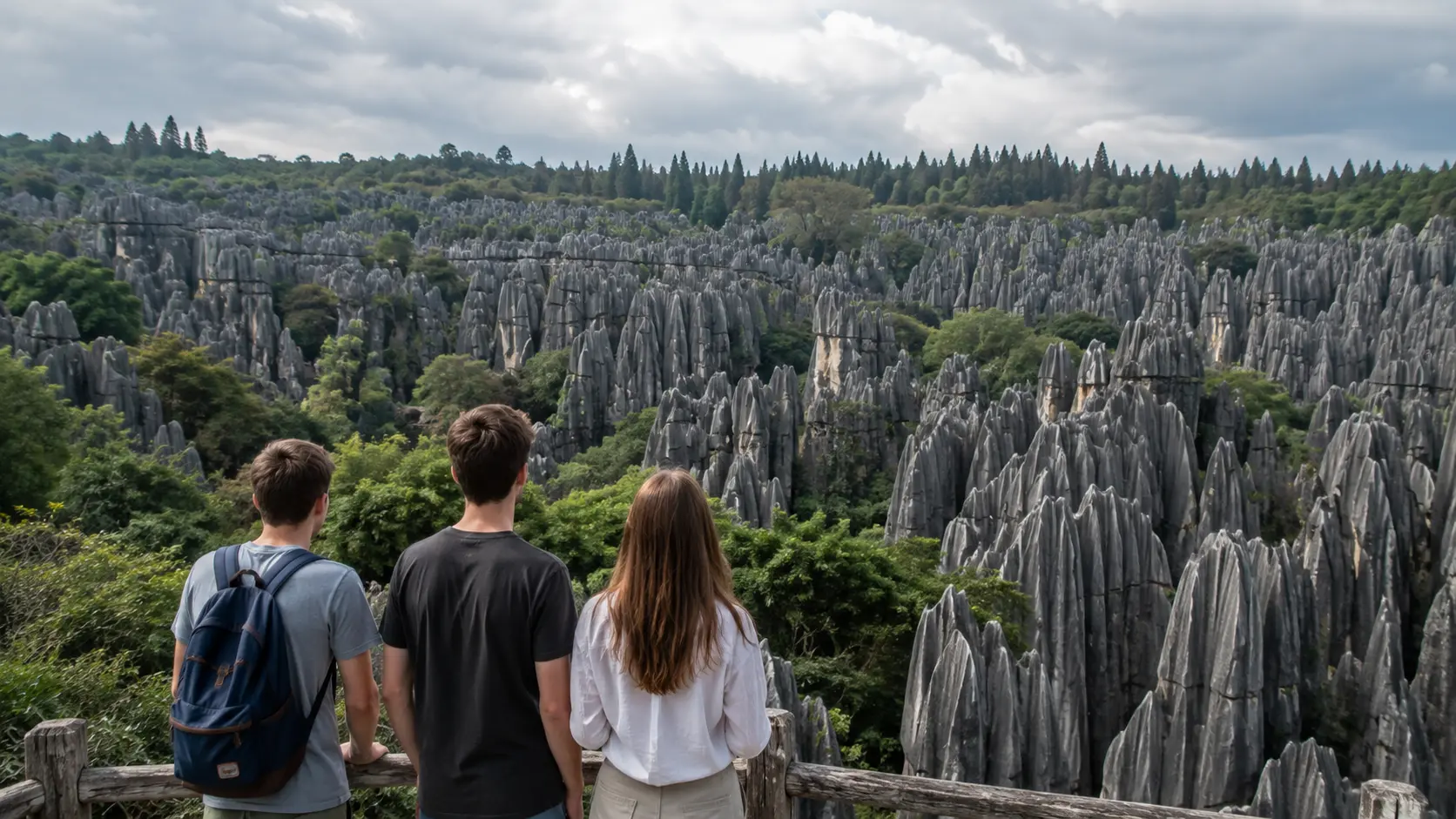
The Stone Forest is the other reason to come to Kunming. It's about 90 kilometres outside the city. Millions of years ago this was seabed, and what's left is a field of grey stone pillars, some as tall as a ten-storey building, standing packed together like trees. You walk on paths between them. It's a UNESCO World Heritage site and there's nothing else like it in the world.
There are many day trips from Kunming to the Stone Forest. You can also just take a bus and walk around by yourself. Either way, it's better to book ahead because tickets sell out.
The other two things to see in the city are Green Lake Park and Yuantong Temple. About an hour for each of these places is enough. Green Lake Park is a big park right in the middle of the city, with willow trees, lotus ponds and old pavilions, where locals come to dance and play music in the afternoons. Yuantong Temple is the oldest Buddhist temple in Kunming.
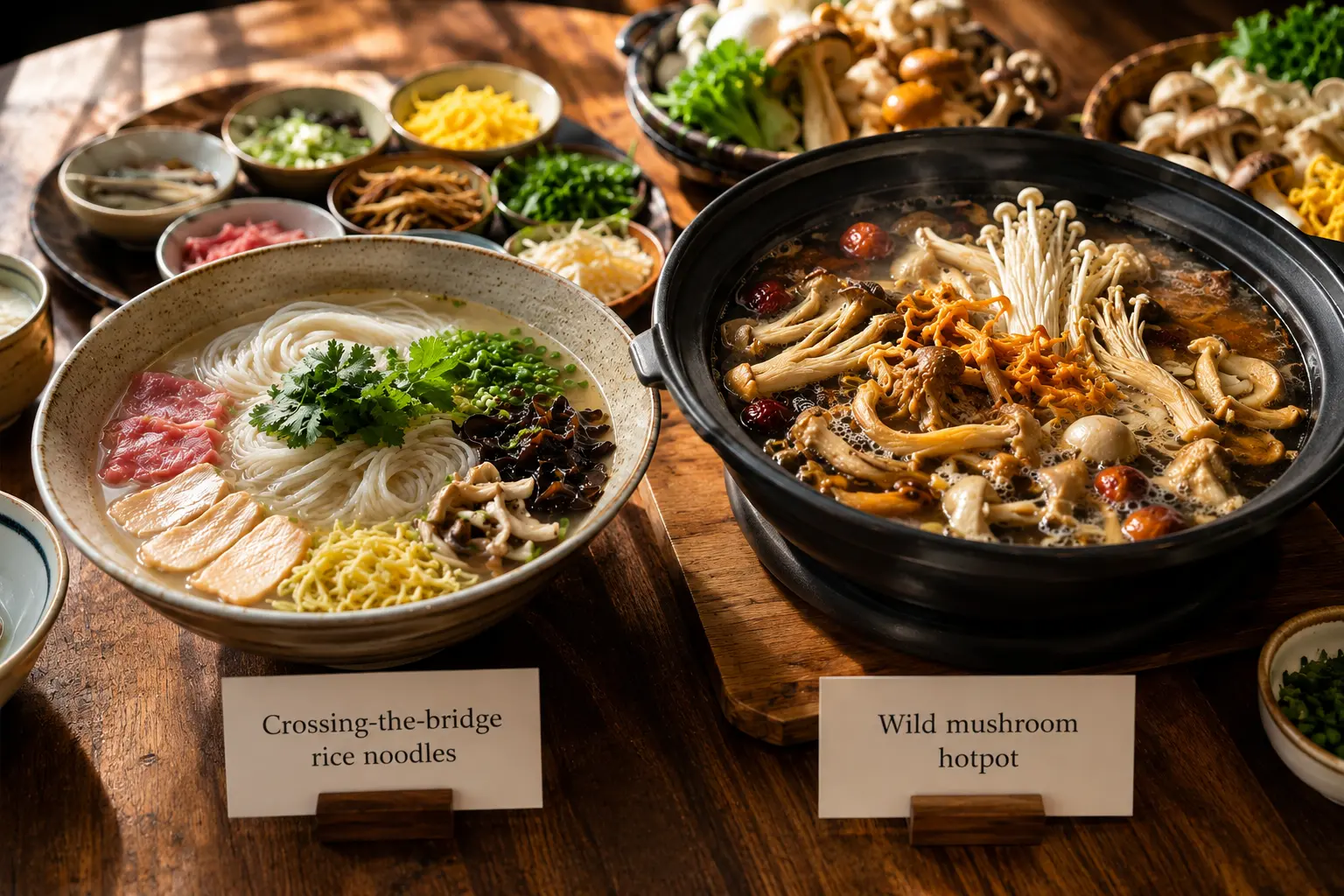
Eat crossing-the-bridge rice noodles. It's Yunnan's most famous dish. A bowl of very hot soup arrives with the raw meat and vegetables on the side. You put them in yourself, and they cook in the bowl in front of you. In summer, try wild mushroom hotpot.
One day is enough for Kunming, unless you need it to rest after a long flight.
Where to Stay in Kunming
Most visitors stay in one of two areas.
Around Nanping Pedestrian Street and the Jinma Biji archways. This is the old heart of the city. Shops, street food, the old street, and most things within walking distance. It's the easiest base if it's your first time.
Around Spring City 66, in Panlong District. The modern centre. Malls, restaurants and the higher-end hotels. Still central, a bit quieter at night.
Green Lake is a third option. Leafy, calm, next to the university, with lots of small guesthouses. Less food and nightlife right outside your door.
Don't stay near Kunming South Railway Station. It sounds handy for catching a train, but it's about 40 minutes from the city centre by car.
These three hotels are all central. They suit different people.
Hotel note. Hotel details and guest experiences can change. Before booking, check the latest room information, location, cancellation terms, and recent guest reviews to make sure the property is right for your trip. This applies to every hotel we mention in this guide.
Hampton by Hilton Kunming Nanping Pedestrian Street is the safe choice. It's a Hilton, so you know what you're getting before you walk in. It opened in 2025, so everything is new. Free breakfast, free gym, and it's right on the main pedestrian shopping street with a metro stop nearby. If you just want a clean, comfortable room and nothing to think about, take a look at this option.
Grand Hyatt Kunming is the one to pick if you want to start your trip somewhere special. The design is modern but built around Yunnan patterns and colours, and it's genuinely beautiful. There's an indoor pool, a sauna, a spa and five restaurants, and it connects straight into a shopping mall so you don't have to go outside at all. Take a look at this option if you want to start the trip well.
Jinbi Hall Hotel is the traditional one. A small courtyard house with only 28 rooms, in the old Jinma Biji quarter. Wooden screens, a private garden in the middle, a tea room, and an outdoor hot tub. Everything is done properly, from the woodwork to the furniture, and it feels like a real old house rather than a hotel made to look like one. Take a look at this option if you want somewhere with character instead of a standard room.
There are also many other options on Trip.com. It's a China-native platform, so it has far more hotels in China than any Western site, and it supports almost every language. We use it ourselves, and it's where we book everything in China.
Dali
Open on every visa-free policy.
Dali is two hours from Kunming by high-speed train, and it's where most people fall in love with Yunnan.
The old town is one of the best kept in China. Stone streets, wooden houses, and a mountain range right behind it. On the other side is Erhai Lake, a big lake about 40 kilometres long.
Dali is the home of the Bai people, one of China's ethnic minority groups. They have lived here for hundreds of years. Bai style shows in the buildings, the food and the clothes.
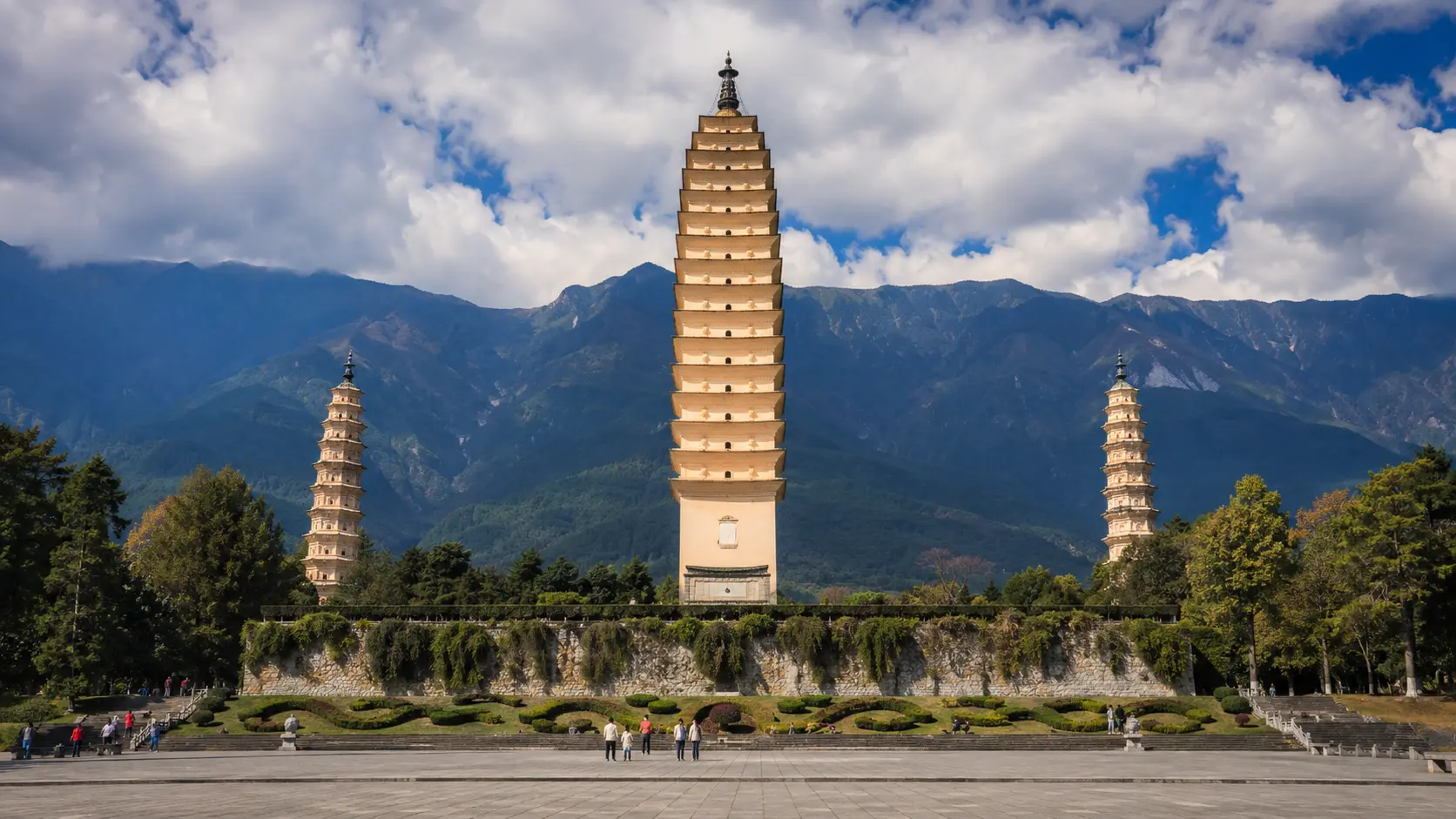
The Three Pagodas are the landmark. Three stone towers, over a thousand years old, and the tallest is nearly 70 metres. It's a twenty-minute walk from the old town.
Going around Erhai Lake is the main thing to do in Dali.
The lake is big. It takes about three hours to drive all the way around it. On one side of the water there's a wall of mountains called Cangshan, green at the bottom and often with snow on top. On the other side there are villages, fields and small harbours.
A path called the ecological corridor runs along the shore, and it's for walking and cycling. Most people hire a bicycle, or one of the shared e-bikes you pick up along the way. Cars and motorbikes can't go in there. If you want to see more of the lake, hire a car with a driver for the day. There's a normal road that goes all the way around the lake.
One thing about scooters. Rental shops call everything an "electric scooter," but the law treats them differently. A slow electric bicycle, up to 25 km/h, doesn't need a licence. Anything faster counts as a moped or a motorbike and does. If you're not sure which one you're being handed, ask, or take a bicycle instead.
There are two places everybody stops. The first is the Panxi S-bend, where the road bends in a long S shape at the very edge of the lake, with the mountains behind it. It's the picture people come to Dali to take. The second is Longkan Wharf, a small wooden pier going out into the water. Go in the morning if you can, when it's quiet and the lake is flat like glass.
End the day in Shuanglang. Dali is located on the west side of the lake, and Shuanglang is straight across the water on the east side, near the top. Go there closer to sunset. That's the view everyone remembers.
Xizhou is a village 20 minutes north of the old town, and it's the easiest place to see how Bai people actually live.
The houses here are built in a square around an open yard in the middle, with all the rooms facing inward. Some of them are two or three hundred years old. A few are open, so you can walk in and look around.
Xizhou is also known for its blue cloth. In small workshops, women fold the fabric and tie it up with string by hand, then dip the whole bundle into a deep blue dye made from a plant. When they untie it, the cloth is white wherever the string was. Every piece comes out different. You can watch them do it and buy a piece at the end.
Next to the village there are rice fields, and a small sightseeing train runs on a track straight through the middle of them. From March to October the fields are bright green, then gold just before the harvest. That's the best time to see it.
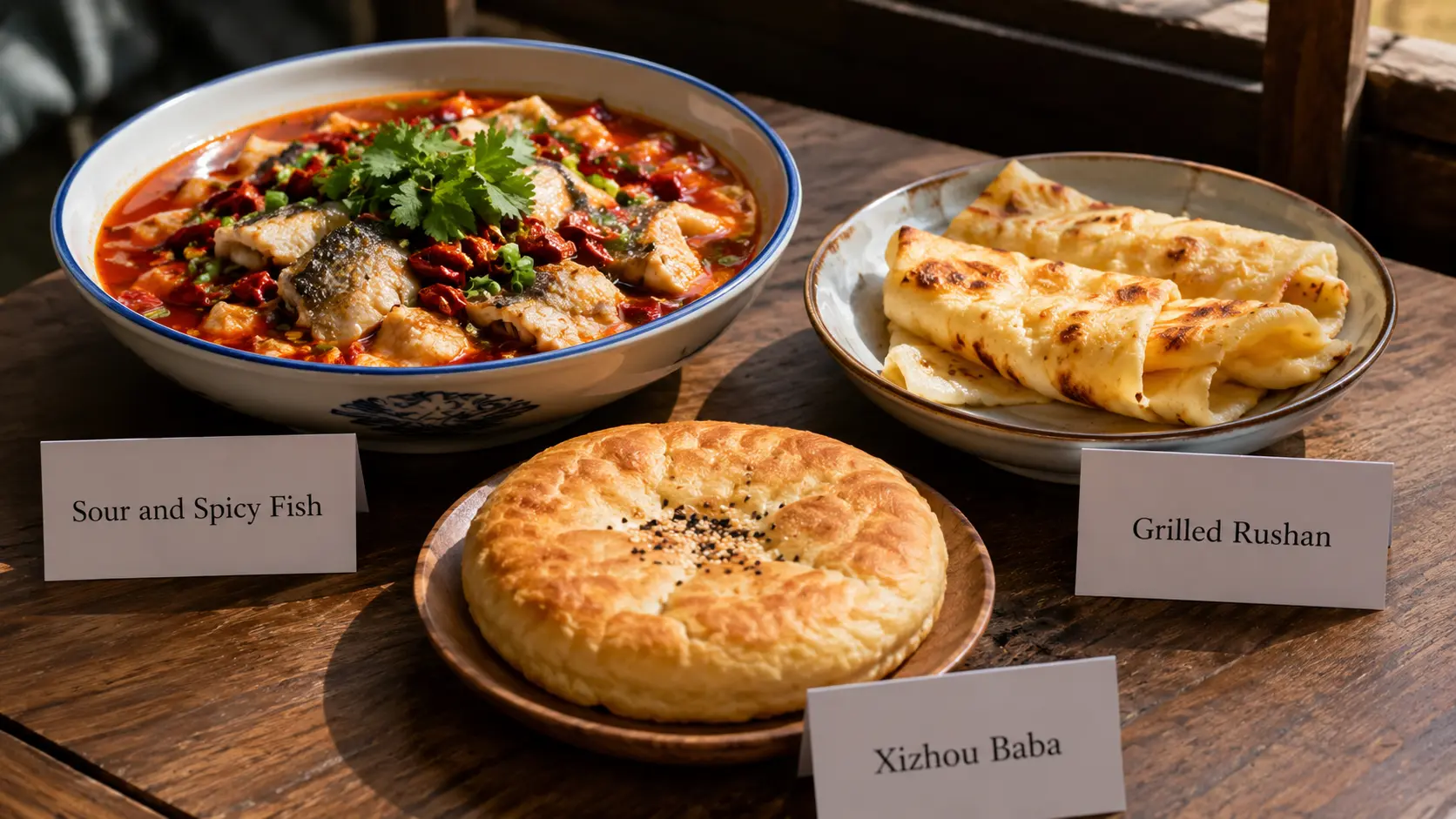
Buy a Xizhou baba from one of the street ovens while you're there. It's a flat round bread, crisp on the outside, sweet with rose jam or savoury with spring onion and pork.
Shaxi is about two hours away, and it's the quietest place on this list.
Hundreds of years ago there were no roads through these mountains. Tea grown here in Yunnan was loaded onto mules and walked all the way to Tibet, where it was traded for horses. The journey took months. That's why it's called the tea-horse road.
Shaxi was one of the towns where the caravans stopped to sleep, eat and trade. It's still standing, and it has barely changed. A few hundred people live there quietly. No crowds, no tour buses.
If you want to see what Dali and Lijiang looked like before the tourists came, this is the place. Give it a full day.
Eat sour and spicy fish and grilled rushan, a stretchy Bai cheese grilled on a stick and eaten hot.
Two or three nights in Dali is enough to see most things, but many people stay longer.
Where to Stay in Dali
Where you sleep changes the whole trip here, so it's worth a minute of thought.
In the old town. You step out onto a stone street with mountains at the end of it. Breakfast, dinner, shops and the bus to the lake are all a short walk away. This is the easy choice, and the right one if it's your first time in China.
By the lake. You open the curtains and the water is right there. It's quiet, the air is clean, and the sunsets are the reason people fall in love with this place. You'll need a scooter or a taxi to go anywhere, so it suits people who want to slow down rather than see everything.
In a village like Xizhou. Rice fields outside your door, old wooden houses, farmers walking past in the morning. After dark there's almost nobody around.
Don't book anywhere near Dali Railway Station. That's in Xiaguan, a separate modern town about 30 minutes south. It looks close on a map, but there's nothing there for you.
Now the good part. Dali is one of the best places in all of China for small, beautiful hotels.
There are barely any big chains here. What you get instead are family guesthouses and old courtyard homes turned into ten-room hotels. People have spent years building these. Some of them are stunning, and they cost a fraction of what something similar would cost in Europe or America.
So take your time choosing. Open Trip.com and actually scroll through, because there are so many options.
Or check out our Trip Planning service. We'll go through hundreds of hotels and pick the exact one that fits your trip, your taste and your budget.
We picked two very different ones, so you can see the range.
Qinglan Cave Style Sea View Hotel is located on the east side of the lake, in a village called Haiyin, looking straight across the water at the mountains. The whole hotel is built to look like the houses on the Greek islands: white curved walls, round doorways, everything painted bright white against the blue of the lake. There are 24 rooms, most with their own heated pool, plus a pool on the roof and a small pink sand beach. They offer free airport and train station pickup. Take a look at this option if you want the lake right in front of you.
The Greence Linn Hillside Hotel is the opposite of that. It's up in the hills on the other side of the lake, and it's just five cabins spread out across a garden, so it never feels like a hotel. The garden is full of flowers and herbs. There's a library, a tea room and two restaurants. From your cabin you look out over the whole lake with the mountains behind it, and you can watch the sun come up without getting out of bed. Take a look at this option if you want to be surrounded by nature.
Lijiang
Open on every visa-free policy.
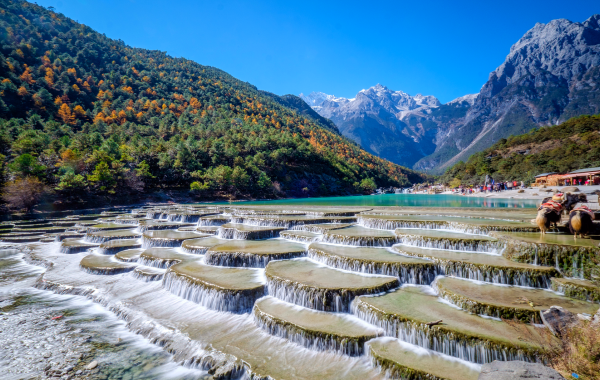
Lijiang is two hours north of Dali by train. It's the most famous town in Yunnan, and the busiest.
Lijiang Old Town is around 800 years old. Instead of roads it has narrow stone lanes, with small canals of clear water running through them and little wooden bridges crossing everywhere. The houses are wooden with grey tiled roofs, and behind all of it stands a snow mountain.
It's beautiful, and it's crowded. The main square fills with tour groups by mid-morning. So it's best to get up early. Go there at seven in the morning, before the shops open, and you can see the whole place while it's still empty.
The town belongs to the Naxi people. They have their own writing, called Dongba, made of little pictures instead of letters. It's the only picture-writing left in the world that people still use. You'll see it on signs and doors all over town.
The Mu Palace was the home of the family who ruled Lijiang for 470 years, twenty-two generations of them. It's a large wooden compound of halls and gardens climbing up the hill. Behind it there is Lion Hill, about ten minutes' walk uphill, and from there you can see the whole town, all the grey tiled roofs, with the mountains standing behind them.
Shuhe is a smaller old town four kilometres away. Stone streets, canals and bridges again, but with a slower pace. Some people go for an afternoon. Others like it so much they stay there instead.
Jade Dragon Snow Mountain is why many people come to Lijiang.
It's a wall of thirteen peaks north of the town, 5,596 metres at the highest point. China still counts the top as unclimbed. Two American climbers said they reached it in 1987, but that has never been officially accepted. The Naxi people believe the mountain is sacred.
The way up is by cable car, and it takes about twenty minutes. It carries you up more than a kilometre. The forest underneath you gets smaller and smaller, then stops completely, and after that it's nothing but grey rock and snow.
You get out at 4,506 metres, right at the edge of a glacier. A glacier is a river of ice that moves so slowly you can't see it moving. This one has been on the mountain for thousands of years.
From there, a wooden walkway and a set of steps carry on up the mountain. Thirty minutes of climbing takes you to the highest platform, at 4,680 metres.
Those steps are much harder than they look. Up this high the air is thinner, so every breath gives you less oxygen than the same breath at home. You'll climb ten steps and have to stop. Your legs feel fine, but your lungs don't. Some people get a headache or feel sick.
So go slowly and sit down whenever you want to. If you start feeling worse instead of better, go back down. Small cans of oxygen are sold everywhere at the bottom. They can help for a minute or two, but there isn't enough in one to fix altitude sickness. Going down is what fixes it.
Bring a warm jacket. It's near freezing up there even in the middle of summer.
They only let a certain number of people up each day, so book ahead.
Blue Moon Valley is at the bottom of the same mountain, and it's included in your Jade Dragon Snow Mountain ticket. You do need to pay separately for the park shuttle bus that takes you there, which is around 20 yuan (≈$3).
Snow melts off the mountain and runs down into a line of shallow pools. The water is bright turquoise, like a swimming pool, but clear enough to see straight to the bottom.
People assume the photos are edited. They aren't. The ice grinds the rock underneath it into white powder, the water carries that powder down, and it turns the pools blue.
Plenty of people like this more than the top of the mountain. Most guides don't even mention it.
Baisha is a small village at the foot of the mountain, and it's where the Naxi kings lived before Lijiang existed. Its temples have paintings on the walls that are 500 years old, mixing Buddhist, Taoist and Naxi gods together in the same picture, which happens nowhere else in China. Not many tourists know about this place.
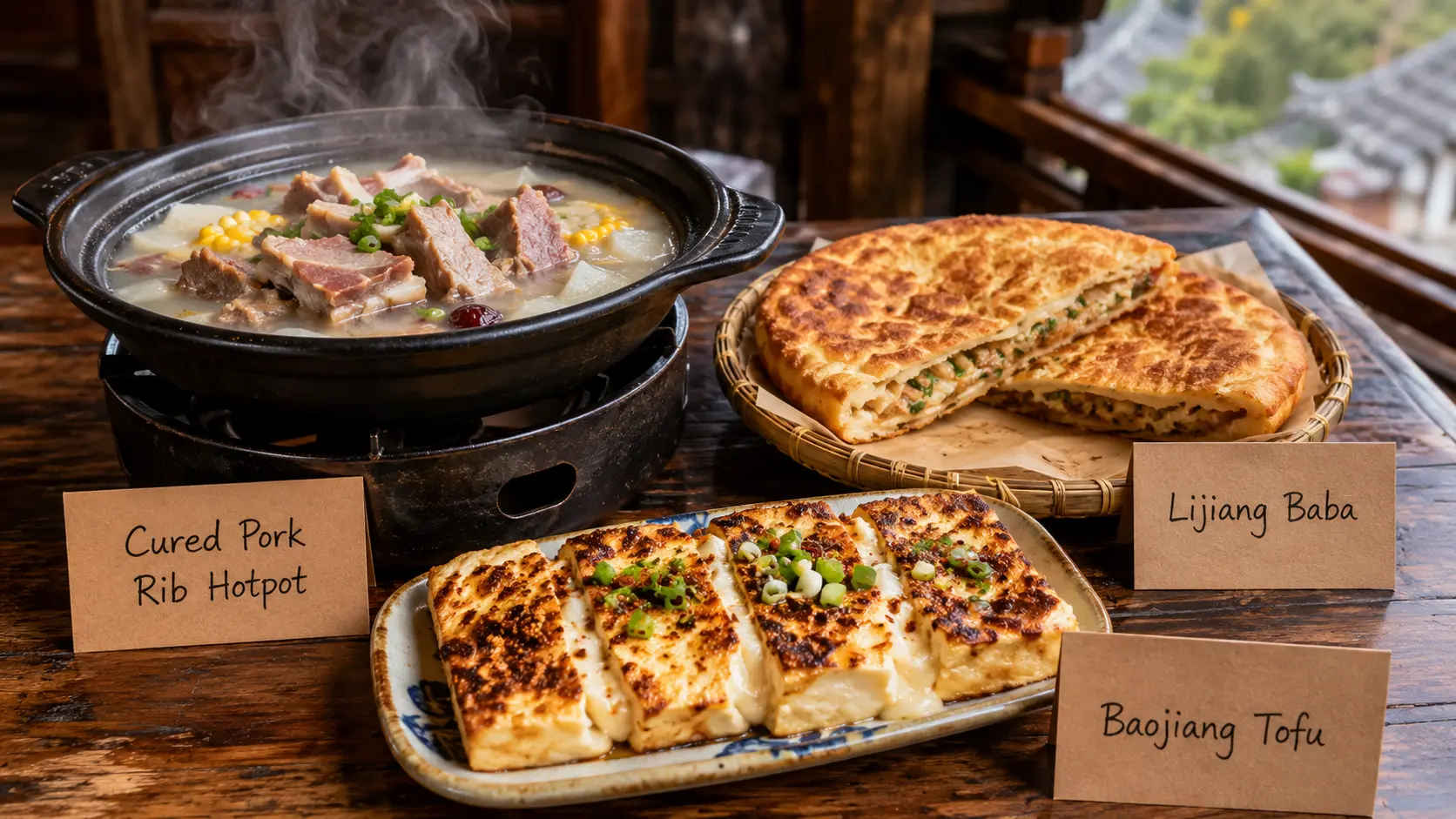
Eat cured pork rib hotpot, a pot of soup cooked at your table with salted ribs in it. Lijiang baba is a fried flatbread, sweet or savoury. Baojiang tofu is grilled until it puffs up and turns molten in the middle.
Two nights is enough for the old town and the mountain. If you stay for three days, you will also have enough time to see the villages.
Where to Stay in Lijiang
There are three places people stay.
Dayan Old Town. This is the main old town. Staying here is convenient because you're in the middle of everything. Food, shops and the main attractions are nearby.
But cars can't drive down most of the lanes, so you might need to walk a bit with your bags. And some streets have bars that get loud at night. Check where the hotel is before you book, and read the reviews from people who stayed there before.
Shuhe. Four kilometres away, quieter, and much easier to reach by car. Still an old town, with the same stone streets and canals.
Baisha or one of the villages under the mountain. Very quiet, with the snow mountain right in front of you. You'll need taxis to get anywhere.
These are two hotels we want to show you. Both are genuinely beautiful, both are used to foreign guests, and both have hundreds of reviews in English on Trip.com you can read yourself.
Lijiang Yunlai Snow Mountain Panoramic Resort is just outside Shuhe, and the whole place is built to face the mountain. The rooms have floor-to-ceiling windows pointing straight at Jade Dragon Snow Mountain, so you can lie in bed and watch the sunrise. There's an outdoor pool, a gym and a tea room, and horse riding is available nearby. Take a look at this option if you want the mountain in front of you.
Lemaison·La Maison is inside the old town, 50 metres from the main entrance and right by the big waterwheel. It's built in the traditional Chinese courtyard style, solid wood throughout, with the rooms arranged around an open yard in the middle. Everything inside is new, though, because it only opened in 2024. There are 32 rooms, a tea room, a café and a restaurant, and the staff speak English. Take a look at this option if you want to wake up somewhere in a different century.
Lugu Lake
Yunnan side open on every visa-free policy. See the note at the end.

Lugu Lake is four to five hours from Lijiang by car, high up in the mountains, and it isn't like anywhere else in China.
The lake is about 2,700 metres up, and the water is so clear you can look down and see the bottom. Mountains stand all the way around it. There are no big towns, just villages along the shore and boats out on the water.
What makes it special is the people who live here. The Mosuo are a culturally distinct community of around 40,000 people living around this lake. In Yunnan they are officially classified as Naxi, the same group as in Lijiang, although Mosuo culture is its own thing.
Traditionally, many Mosuo families are matrilineal. Children take their mother's family name, the house belongs to the mother's side, and the oldest woman in it makes the decisions. The community is best known for a practice called "walking marriage," where a couple don't marry and don't live together. The man visits in the evening and goes back to his own mother's house in the morning, and children are raised by their mother, her sisters and her brothers.
Family life varies a lot today and not everyone lives this way. But it's a real tradition, and it's still part of how the community works.
If you want, you can go out for a boat ride on the lake. The boats here are called pig-trough boats. Each one is a long, narrow canoe cut from a single tree trunk, and the name comes from the shape, because it looks like the wooden trough a farmer fills to feed his pigs.
The ride stops at Liwubi Island, a small island with a temple on it and a white stone tower called a stupa.
At the eastern end of the lake, a wooden bridge runs for hundreds of metres over the water. It's called the Walking Marriage Bridge, and it's where young Mosuo used to come to find each other.
It's on the Sichuan side. That end of the lake is in Yanyuan County, in Liangshan prefecture, which is not open to 240-hour travellers. On the 30-day policy or a mutual exemption, go and see it. On the 240-hour policy, leave it off your list.
At night the villages light bonfires and dance, and visitors are welcome to join in.
One thing to know if you're on the 240-hour policy.
Lugu Lake is right on the line between two provinces, Yunnan and Sichuan, and that line runs through the middle of the water.
The Yunnan side belongs to Lijiang prefecture, so it's open to you. The Sichuan side belongs to Liangshan prefecture, which isn't on the permitted list.
Nearly all the guesthouses and villages, including Lige, are on the Yunnan side, so in practice this is easy. Just don't cross over to the Sichuan bank.
On the 30-day policy or a mutual exemption, both sides are open and none of this applies to you.
It's best to stay at Lugu Lake for two nights, because it's a really long drive for just one.
Where to Stay at Lugu Lake
Most people stay in one of two villages, and both are on the Yunnan side.
Luoshui is the main one. The most guesthouses, the most places to eat, and boats leaving from the shore.
Lige is a smaller village that reaches out into the lake, with water almost all the way around it. It's the one you see in most photos.
Here are two hotels, and both are on the Yunnan side, so they work on every visa-free policy.
Cheman Ruyingsong Mid-Levels Hotel is built halfway up the mountain above Luoshui, so you look down over the whole lake from your room. There are only 24 rooms. Inside there's a library, a tea room, a bar and a garden with cats wandering around it, and they hold Mosuo bonfire evenings for guests. Take a look at this option if you want the view from above.
Chunshi·Youlan is the opposite. It's right next to the water at Daluoshui. Sixteen rooms, built to mix Mosuo style with modern design, and there's a restaurant and a café. You can watch the sun come up without getting out of bed. Take a look at this option if you want to be right next to the lake.
Yuanyang Rice Terraces
Open on every visa-free policy.
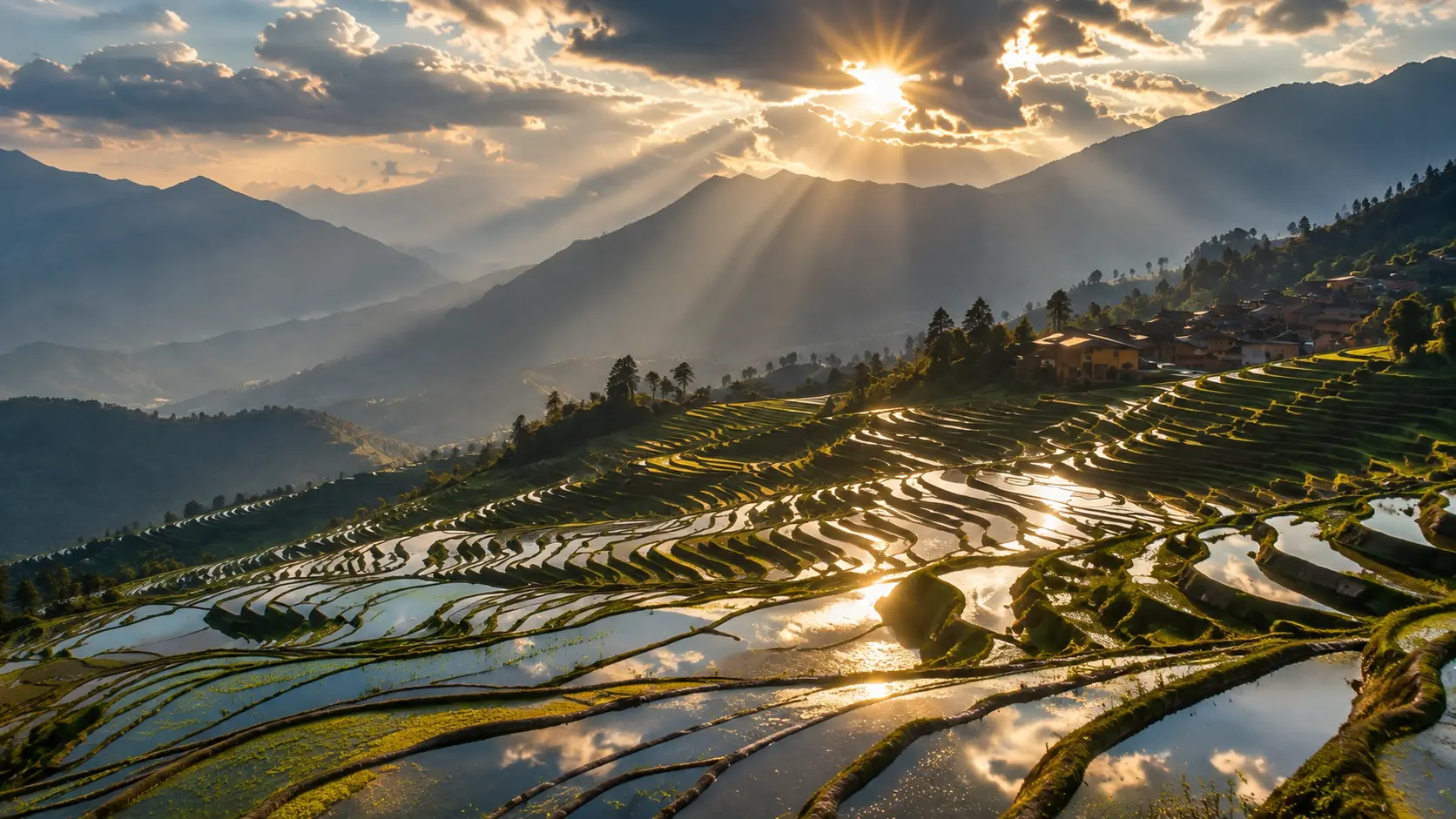
The Yuanyang rice terraces are one of the most beautiful views you can see in China, and hardly any foreign visitors go.
Rice has to grow in flat fields under a few inches of water. Here there is no flat land at all, only steep mountains. So the Hani people, another of Yunnan's ethnic minority groups, cut the mountains into steps.
They have been doing it for about 1,300 years. Every step is a small flat field with a low wall of earth around it to hold the water in, and the steps are stacked one above the other all the way up the slope. On some hillsides there are more than 3,000 of them, climbing over a thousand metres from the river at the bottom to the villages at the top.
Water comes down from the forest above, runs through the villages, and fills each field on its way down the mountain. The whole thing is one system, built by hand, and it still works today.
The time when you go is very important.
The fields are flooded from around late November through to April. At sunrise the light hits the water and the whole mountain turns into thousands of mirrors, each one a slightly different colour. That's the photograph you have seen.
Later in the year the rice is growing, so the terraces are green, then gold just before the harvest. Still beautiful. But the mirrors are what people come for.
Getting there takes five to six hours by bus from Kunming, and there's no train. You stay in Xinjie, a small town in the middle of the terraces.
The viewpoints are spread out around the mountains, 10 to 30 kilometres from Xinjie, and there's no bus that connects them properly. So almost everyone hires a driver for the day through their guesthouse. Ask your hotel a day in advance and they'll arrange the whole thing for you and explain how it works.
There are three main viewpoints, and each one is best at a different time of day.
Duoyishu is the sunrise one, and it's the famous one. You leave your hotel at about five in the morning, in the dark, and wait on the platform for the sun to come up behind the mountains.
Bada and Laohuzui are the sunset ones, so they're much easier. You go in the late afternoon and watch the light turn orange across the water. Laohuzui means "tiger's mouth," after the shape of the valley.
Xishuangbanna
Open on every visa-free policy.

Xishuangbanna is in the far south of Yunnan, right on the border with Laos and Myanmar, and it does not feel like China.
It's hot and wet nearly all year. Palm trees, banana plants, jungle on the hills. The temples are gold with pointed roofs and monks in orange robes outside them, like the ones in Thailand rather than the grey-tiled temples further north.
There's a reason for that. This is the home of the Dai people, and the Dai are closely related to the Thai. Similar language, similar writing, similar Buddhism, similar food. The border here is a line on a map, not a change in the culture.
The main town is Jinghong, on the Lancang river, which becomes the Mekong once it leaves China.
The night market is one of the best things there. It's at Gaozhuang, by the river. Big golden towers lit up in the dark, and hundreds of food stalls underneath them. Grilled fish, sticky rice cooked inside bamboo, and fruit you have never seen before. It's free to go in, and it stays open late.
Dai villages around Jinghong have wooden houses built up on stilts, so that the water and the animals stay underneath in the wet season.
Wild Elephant Valley is an hour north. There are only around 300 wild Asian elephants left in the whole of China, and nearly all of them live in these forests. You walk through the trees on a raised wooden walkway above the ground. You might see one, or you might not.
The Tropical Botanical Garden near Menglun grows more than 13,000 kinds of plant. Half a day goes quickly there.
If you come in mid-April, you'll arrive in the middle of the Water Splashing Festival, which is the Dai new year. For three days everyone plays with water on the streets and people throw water at each other. You will get soaked, but it's so much fun.
Getting there is easier than most guides say. The China-Laos Railway opened in 2021, and there are direct trains from Kunming that take three to four hours. It isn't a full high-speed line, the trains run at up to 160 km/h, but they're modern Fuxing trains and the ride is comfortable. Flying takes about an hour.
Two or three nights is enough.
Getting Around
Trains are the best way to move around Yunnan. Chinese high-speed trains are fast, clean, cheap, and they leave on time. The seats are bigger than on a plane, and most seats have a socket for charging your phone.
| Route | How | How long |
|---|---|---|
| Kunming to Dali | High-speed train | about 2 hours |
| Dali to Lijiang | High-speed train | 1.5 to 2.5 hours |
| Kunming to Xishuangbanna | Direct train | 3 to 4 hours |
| Kunming to Xishuangbanna | Flight | about 1 hour |
| Lijiang to Lugu Lake | Car, no train | 4 to 5 hours |
| Kunming to Yuanyang | Bus, no train | 5 to 6 hours |
| Lijiang to Shangri-La (30-day and mutual exemption only) | High-speed train | about 1 hour 20 minutes |
You need your passport. In China every train ticket is tied to a passport number. You use it to book, and you show the passport itself at the gate to get on the train. Bring the real one, not a photo. Get to the station about thirty minutes early, because there's a bag scan and an ID check before you reach the platform.
You can book train tickets here in English, or use China's official railway app, called 12306, if you'd rather book direct.
Buses to Yuanyang leave from Kunming's East Bus Station, and you usually buy the ticket at the station. For Lugu Lake, most people take a shared car, and the hotel usually can help arrange that.
Dali trains leave from two stations in Kunming. Kunming Station is in the city centre. Kunming South is about 40 minutes out by car. Both have trains to Dali, so check which station your train leaves from when you book. Kunming Station is much more convenient, so pick a train from there if one suits your timing.
There is a train to Shangri-La now. Older guides say there isn't. It opened in November 2023 and takes about an hour and twenty minutes from Lijiang, for around 50 to 65 yuan, which is $7 to $9. That only helps you on the 30-day policy or a mutual exemption, because Shangri-La is closed to 240-hour travellers.
5-Day Yunnan Itinerary
This one works on every visa-free policy. Every stop is somewhere you're allowed to go.
Day 1. Land in Kunming.
If you arrive in the morning, go to the Stone Forest for the afternoon. If your flight lands late, go to Haigeng Dam on Dianchi Lake instead, feed the seagulls and watch the sun go down over the water.
Day 2. Kunming to Dali.
Morning train, two hours. Kunming Station in the city centre is the more convenient of the two stations, so book from there if a train suits your timing. Check out the old town, walk the stone streets, see the Three Pagodas, and eat dinner somewhere on the main street.
Day 3. Dali.
Hire a bicycle and ride the ecological corridor along the west side of Erhai Lake. Stop at the Panxi S-bend and Longkan Wharf. Go to Shuanglang and be there for sunset.
Day 4. Dali to Lijiang.
Spend the morning in Xizhou village and see the little sightseeing train in the rice fields. Take the afternoon train to Lijiang. Walk around the old town, then find a local restaurant for dinner and try the cured pork rib hotpot, Lijiang baba and baojiang tofu.
Day 5. Lijiang, then home.
Go up Jade Dragon Snow Mountain in the morning and see Blue Moon Valley on the way down. Book your tickets in advance. Take the late afternoon train back to Kunming and fly back the next day.
Five days is tight but comfortable, and you'll have seen the heart of Yunnan.
10-Day Yunnan Itinerary
Open to all the visa-free policies.
Day 1. Land in Kunming.
Stone Forest if you arrive early, Dianchi Lake if you arrive late.
Day 2. Kunming to Dali.
Morning train from Kunming Station. Old town in the afternoon.
Day 3. Dali.
Erhai Lake by bicycle along the ecological corridor. Panxi S-bend, Longkan Wharf, and sunset at Shuanglang.
Day 4. Dali.
Xizhou village and the sightseeing train, or take a car out to Shaxi for the day.
Day 5. Dali to Lijiang.
Train in the morning. Lijiang old town, the Mu Palace and Lion Hill in the afternoon.
Day 6. Jade Dragon Snow Mountain.
A full day, including Blue Moon Valley. Back in Lijiang for the evening.
Day 7. Lijiang to Lugu Lake.
Four to five hours by car. Settle in on the Yunnan shore.
Day 8. Lugu Lake.
Take a boat out to Liwubi Island in the morning. Cycle or walk part of the Yunnan shore in the afternoon. Join the bonfire dancing in the evening. If you're on the 240-hour policy, stay on the Yunnan side of the lake, which means skipping the Walking Marriage Bridge.
Day 9. Lugu Lake to Lijiang.
A driving day. Spend the rest of the day in Shuhe or Baisha.
Day 10. Lijiang to Kunming, then home.
Morning train, then your flight.
If you travel between late November and April, go to the Yuanyang rice terraces instead of Lugu Lake. Take a bus from Kunming, spend two nights in Xinjie, and get up before sunrise. That's when the fields are flooded, and when the sun comes up the whole mountain looks like thousands of mirrors.
If you're on the 30-day policy or a mutual exemption, add Shangri-La. Take the train from Lijiang, spend two nights there, see Songzanlin Monastery and the old town, then come back.
If after reading this guide you feel a little overwhelmed and it feels like too much new information, check out our Trip Planning service.
Trip Planning is where we build the whole route for you. Which places, in what order, how many days in each, where to stay, and how to get between them. We hand you the plan and you book everything yourself, so you can change whatever you want as you go.
What to Bring
- Your passport. On the 30-day policy it has to be valid for at least as long as you're staying. On the 240-hour transit policy you need at least three months left on it from the day you arrive. If your passport is expiring soon, renew it before the trip.
- Your arrival card. Do it online before you fly at s.nia.gov.cn, or fill in a paper one when you land. Our China entry requirements guide explains the arrival card step by step.
- A ticket out of China. On the 240-hour policy this is required, and it has to be to a third country, not back to where you came from. On the 30-day policy it isn't officially required, but it's good to have one.
- Hotel bookings for your first few nights, or the address of wherever you're staying.
- A rough plan of the cities you're going to and what you're planning to see there. It doesn't need to be very detailed, but you should be able to explain it to the officer.
Another thing that is very important for people travelling on the 240-hour transit policy is to stay inside the nine open prefectures. So keep the plan on your phone in case anyone asks to see it.
Book your hotels and flights on a China-native website like Trip.com. The choice across Yunnan is far better, and a lot of the small guesthouses in Dali, Lijiang and around Lugu Lake don't appear on international sites at all.
Before You Go
None of these are immigration requirements. They're the things that decide whether your first few hours in China are smooth or frustrating.
Get mobile data before you fly. Get a China eSIM or international roaming before you leave home, so the internet works the moment you land. You can also buy a SIM card at the airport for the length of your stay.
Download a VPN. Google, Gmail, WhatsApp and Instagram are apps most people use every day, and none of them work in China without a VPN. Our China VPN guide covers which ones actually work. If you get an eSIM that's specifically for a China trip, it usually has a VPN built in, so you may not need a separate one. Even then, download one or two before you leave. The moment you connect to hotel or café Wi-Fi, your eSIM isn't handling the connection anymore, and you'll need a VPN again.
Set up Alipay or WeChat Pay. Almost everything in China is paid by phone. Link your card to one of these apps before you fly. As a safety measure, carry a bit of RMB cash as a backup, in case something goes wrong with the internet, your cards, or anything else. That way you've got money for a taxi from the airport or a few small basics while you sort the problem out.
Setting these apps up from home can be confusing, and a lot of the tutorials online are out of date. So we made our own. Our China payment setup guide shows both apps step by step, with screenshots from 2026. You'll see how to download them, register, add your card, and verify your identity. Every tap and every field is in there, so you just follow along and know it's done right before you fly. It's $4.90 and you get it straight away.
If you'd rather have all of it in one place instead of hunting through separate articles, we've put everything into one big PDF guide. Buy it once and it's yours to keep.
Want Us to Help?
Route Review. Send us the route you're planning and we'll check it against the rules before you book anything. We'll tell you which policy your passport qualifies for, and whether every stop on your list is somewhere you're actually allowed to go. Yunnan is where people get this wrong more than anywhere else in China, because the rules change from one prefecture to the next.
Or just email us and tell us what you're planning.
FAQ
Can I visit Shangri-La without a visa?
On the 30-day policy or a mutual exemption, yes. On the 240-hour transit policy, no. Shangri-La is in Diqing prefecture, which isn't on the permitted list.
Which parts of Yunnan can I visit on the 240-hour policy?
Nine prefectures: Kunming, Yuxi, Chuxiong, Honghe, Wenshan, Pu'er, Xishuangbanna, Dali and Lijiang. That covers Kunming, the Stone Forest, Dali, Lijiang, Jade Dragon Snow Mountain, Blue Moon Valley, the Yunnan side of Lugu Lake, the Yuanyang terraces and Xishuangbanna.
Can I go to Lugu Lake on the 240-hour policy?
Yes, but only the Yunnan half. The lake is split between two provinces. The Yunnan side is in Lijiang prefecture and is open to you. The Sichuan side is in Yanyuan County, Liangshan prefecture, and isn't. That includes the Walking Marriage Bridge. Nearly all the guesthouses are on the Yunnan side, so it's easy to stay on the right one.
What happens if I go somewhere I'm not allowed?
Usually you'll be stopped before it becomes a problem, at a hotel check-in or at a checkpoint. But it breaks the conditions of your entry, and that can affect this trip and future ones. Don't risk it.
How many days do I need in Yunnan?
Five days covers Kunming, Dali and Lijiang. Seven to ten lets you add Lugu Lake or Xishuangbanna. Add two or three more for Shangri-La if you're allowed to go.
When is the best time to go?
March to May and September to November. Mild weather and fewer people. Two exceptions: the Yuanyang terraces are flooded from around late November to April, and the seagulls only come to Kunming from November to March. Avoid the national holidays, October 1 to 7 and Chinese New Year, unless you don't mind crowds.
Do I need to book hotels in advance?
In Dali and Lijiang in high season, yes. Smaller places you can usually sort out when you arrive. Either way, having a booking to show at the border is useful.
Will I get altitude sickness?
Maybe, at Jade Dragon Snow Mountain and Lugu Lake. Kunming, Dali and Lijiang are all around 1,900 to 2,400 metres, which most people handle without noticing. The mountain platform at 4,680 metres is different. Go slowly, drink water, and go back down if you feel worse instead of better.
Can I cross into Laos, Vietnam or Myanmar from Yunnan?
Some crossings are open to foreigners and some aren't, and the rules change. More importantly, the moment you leave mainland China your visa-free stay ends. That's true on every policy, and you can't come back on the same entry.
Is Yunnan safe?
Yes. It's one of the safest parts of China for visitors. Watch your bag in crowds, the same as anywhere.
What should I pack?
Layers. The height changes everything here. Kunming is mild all year. Dali and Lijiang get cold in the mornings and evenings. Lugu Lake is colder still. Xishuangbanna is hot and wet. Bring a light jacket, comfortable shoes for cobblestones, sunscreen and a hat. The sun at this altitude is much stronger than it feels.
Where do I book tours and tickets?
Most people use Trip.com. It has English-language day trips, Jade Dragon Snow Mountain tickets, Erhai Lake bicycle hire and Stone Forest entry.
Bottom Line
Yunnan is one of the most beautiful provinces in China, and most of it is open to visa-free travellers.
On the 30-day policy or a mutual exemption, all of it is yours. On the 240-hour transit policy you get nine prefectures, which covers Kunming, Dali, Lijiang, the Yunnan side of Lugu Lake, the Yuanyang terraces and Xishuangbanna. Shangri-La is the main thing you miss.
Five days is enough for Kunming, Dali and Lijiang. Seven to ten lets you slow down or add Lugu Lake and the south.
Meeting the conditions doesn't guarantee entry. The officer at the border always makes the final decision. If you have a question before you book, call the China Immigration Service Hotline on 12367 inside China, or +86-12367 from outside.
Sources
- National Immigration Administration — 240-hour visa-free transit policy and permitted regions
- National Immigration Administration — mutual visa exemption agreements by passport type
- National Immigration Administration — China Immigration Service Hotline 12367
- Ministry of Foreign Affairs — visa-free entry policies