
Last updated: September 2, 2026 Some links are affiliate links — see our Affiliate Disclosure.
Chengdu Layover: What to Do Visa-Free
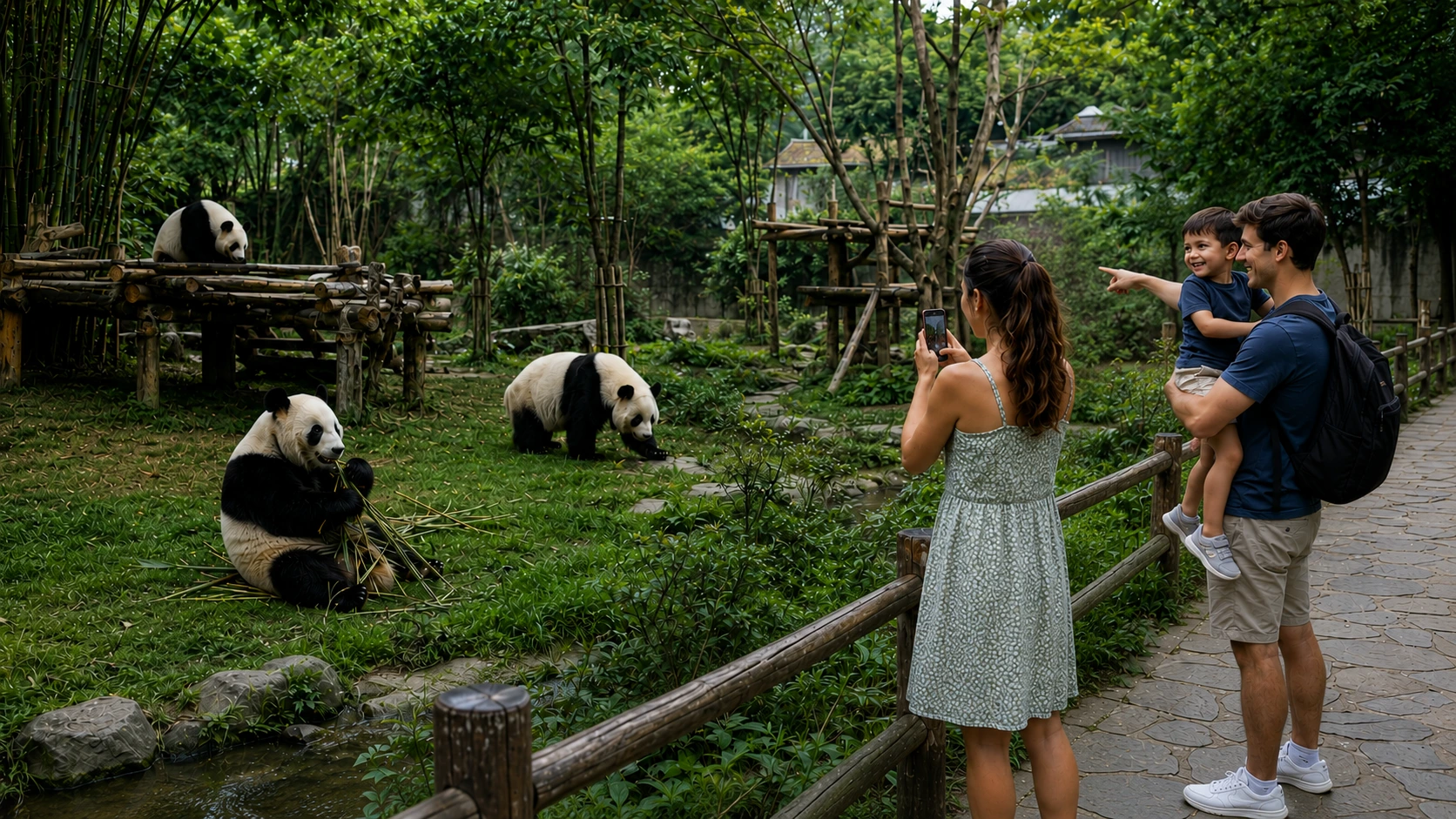
Got a layover in Chengdu? Depending on your passport, your route, and how long you're stopping, you may be able to leave the airport and explore the city without a Chinese visa. That could be a few hours with the pandas and a hot pot dinner, a couple of days around Chengdu, or a longer trip out to the Leshan Giant Buddha.
Which route you use depends on your nationality and trip. Most travelers stopping on the way to a third country use the 240-hour transit policy, which gives up to 10 days and is what this guide mainly covers. A shorter 24-hour visa-free transit is open to almost all nationalities, but it doesn't automatically let you leave the airport: to enter the city you have to ask immigration for a temporary entry permit. And if your country is on the 30-day visa-free list, you don't need to think about transit rules at all: leaving the airport counts as a normal visa-free visit, so you can enter the city without the third-country rule and stay for the length of your layover, up to 30 days.
❗ Important. The 240-hour transit's stricter rules — the onward ticket to a third country, the 10-day limit, and the permitted-area restrictions — only apply to passports that are on the transit list but not the 30-day list. Right now that's just the United States, Mexico, Indonesia, the Czech Republic, Lithuania, Ukraine, Kyrgyzstan, and Vietnam. If your passport isn't one of those and your country is on the 30-day visa-free list, you can ignore those rules completely as you read — just arrive and explore, up to 30 days.
Below, alongside the entry rules, you'll find a simple Chengdu itinerary you can scale to your time. It lists how long it takes to get from the airport into the city and roughly how long each stop takes, with tickets you can book ahead, so even a short half-day out is easy to plan and make the most of.
What the 240-Hour Transit Policy Covers
The 240-hour visa-free transit lets ordinary-passport holders from 57 eligible countries enter China without a visa while traveling on to a third country or region, and stay up to 10 days. It runs through 65 designated ports across 24 provincial-level regions, and Chengdu is covered.
You don't apply ahead of time; you're processed at the port when you arrive. If you're not sure which policy fits your passport, our visa-free countries hub shows it, and the full rules and country list are in our 240-hour transit guide.
If your nationality is on China's 30-day visa-free list, you don't need to worry about the transit rules at all. You don't need an onward ticket to a third country, and the route rule below doesn't apply to you. You simply enter China and stay for as long as your layover lasts, up to 30 days, and explore. For most people on that list, this is the simplest option. The 240-hour transit is the main route for travelers who aren't on the 30-day list, like US passport holders.
The Route Rule That Decides Everything
You need a valid passport and a confirmed onward ticket (or other accepted proof of departure), with set dates and a route to a third country or region. Your onward departure can be by air, rail, ferry, or another permitted international route through an eligible port, not only by plane. The key: the place you arrive from and the place you leave for must be different. Mainland China has to sit between two different countries or regions on your trip.
Routes that qualify:
- Bangkok → Chengdu → Singapore: you arrive from Thailand and leave for Singapore. Two different countries. Qualifies.
- Los Angeles → Chengdu → Tokyo (Tokyo can just be a layover, not a real stop): you arrive from the US and leave for Japan, so it qualifies. The rule only cares that your next stop after China is different from where you came from.
Routes that don't qualify:
- Bangkok → Chengdu → Bangkok: same country before and after China. Does not qualify.
- Hong Kong → Chengdu → Hong Kong: same region before and after. Does not qualify.
Hong Kong, Macao, and Taiwan count as separate regions from mainland China here, so flying out to Hong Kong satisfies the rule. The simplest way to qualify: leave China for a different country or region than the one you arrived from, even if it's just a layover. You don't have to actually stop there. If your trip is more complicated than "fly in from one place, fly out to another," confirm with your airline before booking that your route still qualifies.
Where You Can Enter
Chengdu has two eligible airports for the 240-hour transit, and both handle international flights:
- Chengdu Tianfu International Airport (TFU) — the newer main hub, south of the city
- Chengdu Shuangliu International Airport (CTU) — the older airport, closer to the centre
You can fly into one and out of the other, as long as your onward flight leaves China for a third country or region within your 240 hours. Not sure your exact airport qualifies? Use the checker below.
When the 240 Hours Start
Your 240-hour window is counted from 00:00 on the day after you enter, not from the moment you land. So arriving in Chengdu on a Monday afternoon, the clock starts at midnight going into Tuesday, which gives you a little extra time on arrival day. Check the exact permitted-stay deadline shown on your temporary entry permit and leave before it expires.
Where You Can Travel
The travel-area limits below are for 240-hour transit travelers only. If your passport is on the 30-day visa-free list, they don't apply to you — you're free to travel almost anywhere in mainland China for your whole stay, so the rest of this section isn't something you need to worry about.
Most travelers spend their layover in Chengdu itself, since that's where they land and where the pandas are. Entering at Chengdu, your local permitted area is Chengdu and certain other cities in Sichuan, not the whole province. The most useful for a short trip:
- Chengdu — the pandas, hot pot, Jinli and Kuanzhai old streets, and the teahouses of People's Park
- Leshan (乐山) — the Leshan Giant Buddha, about an hour away by high-speed train
- Other permitted Sichuan cities, including Meishan (眉山), Ya'an (雅安), and Deyang (德阳)
You're not strictly confined to Sichuan, either. The policy also lets you move between the officially permitted stay areas in other participating regions during the same 240-hour stay. It isn't unrestricted nationwide travel, though: every destination has to be inside a permitted area, and you must exit through an eligible port before your stay expires. For the full list of permitted regions and how the policy works, see our 240-hour transit guide.
What to Do on Your Layover
Here's an easy plan for leaving the airport and seeing the city. If you've only got a few hours, pick one or two things from the top of the list. If you've got a day or two, you can do most of it. Next to each stop is a rough idea of how long you'd want to spend there, so you can fit it around your flight — but that's just a guide, so go at your own pace. If you tend to take longer than planned, give yourself more time. Where a place needs a ticket, we've linked it so you can buy ahead and skip the line.
Getting in from the airport. The ride itself is about 50 to 60 minutes from Chengdu Tianfu (TFU) and about 30 to 40 minutes from Chengdu Shuangliu (CTU), by metro or taxi. But count the whole process, not just the ride. By the time you leave the terminal, collect your luggage, find the metro or the taxi rank, and handle the small stuff like a bathroom, some water, and figuring out the signs for the first time, you're realistically looking at about 1 hour to 1 hour 30 door to door. Build that in so you're never cutting it close for your flight out. The trip back is usually faster, since from the city you can order a taxi to your exact spot and it drops you right at the terminal.
Don't be shy about asking for help. Keep an offline translator on your phone, and if you get stuck (ordering a car through Alipay or the DiDi app, finding the taxi pickup, or finding where your driver is parked) just show it to any airport staff member or a passer-by. Chinese people are genuinely helpful. Someone will often call your driver, talk to them in Chinese, and point you the right way. It's faster and far less stressful than figuring it out alone, especially when you've only got a few hours in the city. Foreigners in China do this all the time, so don't overthink it.
Day 1 — Chengdu
The pandas, about 2.5 to 3 hours. The base is about 10 km north of the city centre, roughly 30 to 40 minutes by taxi. The Chengdu Research Base of Giant Panda Breeding (大熊猫繁育研究基地) is the reason most people stop here, and it's worth it: dozens of giant pandas (and fluffy red pandas) rolling around, munching bamboo, and climbing trees in a big leafy park. Go early, when they're most active and it's still quiet. Book your tickets in advance, especially for weekends and public holidays, when it's busiest.
Jinli Ancient Street & Wuhou Shrine (锦里 / 武侯祠), about 1.5 to 2 hours. These two sit side by side in the city centre. Jinli is a lantern-lit old street packed with snack stalls, tea houses, and little shops, and the Wuhou Shrine beside it is a peaceful temple and garden honouring heroes of the Three Kingdoms. Together they're an easy, atmospheric afternoon, and the street food is a highlight.

Kuanzhai Alley (宽窄巷子), about 1 to 1.5 hours. A set of restored old lanes full of teahouses, courtyard cafes, snack stalls, and souvenir shops, right beside People's Park and about 15 to 20 minutes from Jinli. Good for a slow wander and a cup of tea between sights.
People's Park teahouse (人民公园), about 1 hour. Right in the city centre, next to Kuanzhai Alley, this is where locals come to slow down. Rows of bamboo chairs sit under shady trees, with people playing cards and mahjong, and at the famous Heming Teahouse you can settle in for hours over a bottomless cup of tea. You can even get your ears cleaned here, an old Sichuan tradition. It's the most relaxing stop of the day.
Day 2 — Leshan Giant Buddha
Take the high-speed train down (about an hour) to see one of China's great sights.
Leshan Giant Buddha (乐山大佛), about half a day. This is one of those sights that doesn't feel real until you're standing next to it: a 71-metre Buddha carved straight into a red cliff more than 1,200 years ago, looking out over the spot where three rivers meet. It's the biggest stone Buddha on earth, and when you walk down the staircase beside it, your whole body barely reaches its foot. One of the most jaw-dropping things you can see in China. Book your tickets in advance, since it gets busy on weekends and holidays. There are also guided day tours that pick you up in Chengdu, take you straight to Leshan, and show you around with a guide who speaks English (or your own language) — the easy, no-stress way to do it. Book a Leshan day tour here.
Short on time? If you've only got half a day, just pick one main thing — the pandas in the morning or the Leshan Giant Buddha — and book the ticket before you land so you don't lose time at the counter.
However you spend the day, the classic way to end a Chengdu evening is Sichuan hot pot: spicy, social, and a proper experience. You usually don't need to book — just walk in. An easy, safe bet is Haidilao, a hugely popular chain you'll find all over China, known for its over-the-top service and English menus. For something memorable afterwards, catch a Sichuan opera face-changing show, worth booking ahead. You can book the tickets and tours in this guide on Trip.com, which lists English-language tickets, tours, and airport transfers across Chengdu.
What You Can Do — and What You Can't
You can use the time for tourism, business, visits, and exchanges. You can't take paid work, study, or report as a journalist; those need the right visa.
What to Carry at the Border
Have these ready when you arrive at Chengdu immigration:
- A valid passport or travel document. The policy asks for at least 3 months of validity, but 6 months is the safer bet — airlines and other checks sometimes want it, even though the policy itself doesn't
- A confirmed onward ticket to a third country or region, departing within your 240-hour window
- The Arrival Card for foreigners — you can fill it in online before you fly, or complete a paper card at the airport
- Your hotel booking or accommodation address in Chengdu, in case the officer asks
When immigration asks why you're entering, transit travelers should mention they're using the 240-hour visa-free transit policy, so the officer applies the right rules. (If you're entering on the 30-day visa-free policy instead, just say you're visiting visa-free.) You don't apply ahead of time; the officer processes you when you arrive. Getting all your documents prepared and in order is important, but it doesn't on its own guarantee entry — as the policy itself states, the final decision is always made by the immigration officer at the port.
Getting Ready for the Trip
Once your tickets are sorted, set a few things up before you land. You'll want a China eSIM for data the moment you arrive, a VPN installed before you go so you can still use apps like Google, WhatsApp, and Instagram inside the mainland, and WeChat and Alipay on your phone so you can pay the way locals do. You can book your flights and Chengdu hotels on Trip.com, which has strong mainland coverage and plenty of refundable options. Our first-China-trip guide shows you how to set all of it up.
Want everything in one place? We've put it into a single downloadable guide that covers entry rules, apps, payments, and getting around, with screenshots, plus our own checked picks for places to eat and visit across a number of cities.
FAQ
Can US citizens use this policy in Chengdu?
Yes. US citizens are eligible for the 240-hour visa-free transit policy. You need a confirmed onward ticket to a third country or region within 240 hours, and you must enter through an eligible port and meet the other conditions. Final approval is always made by immigration inspection authorities at the port.
How long can I stay?
Up to 240 hours, which is 10 days. The clock starts at 00:00 on the day after you arrive, so your arrival day is essentially a bonus.
Do I need an onward ticket?
Yes. You need a confirmed ticket, with a fixed date, to a third country or region, leaving China within 240 hours of entry. The place you fly out to must be different from the place you arrived from.
Can I visit the pandas?
Yes. The Chengdu Research Base of Giant Panda Breeding is in Chengdu, inside the permitted area, and it's the number-one reason most travelers use this policy. Go early in the morning when the pandas are most active, and book your ticket ahead.
Can I visit Chongqing on this policy?
Yes. The whole Chongqing municipality is a permitted area under the 240-hour transit, and it has its own eligible airport, Chongqing Jiangbei International Airport (CKG). Because the policy lets you travel between permitted areas, you can head from Chengdu to Chongqing during your stay — just keep the whole trip inside your 240 hours and leave through an eligible port. And if your country is on the 30-day visa-free list, you can travel almost anywhere in mainland China, with none of these transit limits at all.
What if I want to stay longer than 10 days?
It depends on your passport. Most travelers can just enter on the 30-day visa-free list and stay up to 30 days — no onward ticket, no transit rules. The 10-day cap only applies to passports that aren't on the 30-day list and have to use the 240-hour transit instead: the United States, Mexico, Indonesia, the Czech Republic, Lithuania, Ukraine, Kyrgyzstan, and Vietnam. If that's you and you want longer than 10 days, you'd need a regular visa.
Where do I book tours and activities in Chengdu?
The two platforms most travelers use are Trip.com and Klook. Both list English-language panda-base tickets, Leshan Giant Buddha day trips, Sichuan opera face-changing shows, hot-pot experiences, and airport transfers across Chengdu.
Sources
- National Immigration Administration — Visa-Free Transit Policies
- National Immigration Administration — 10 New Immigration Measures (Nov 2025)
- National Immigration Administration — Visa-Free Transit Fully Relaxed and Optimized (cross-province travel)
- State Council — China Widens Visa-Free Access (Nov 2025)
Bottom Line
Chengdu is covered by China's 240-hour visa-free transit, which gives travelers from 57 eligible countries up to 10 days with no visa. The one firm rule is that mainland China must sit between two different countries or regions on your trip, like Bangkok → Chengdu → Singapore or Los Angeles → Chengdu → Tokyo. You enter through Chengdu Tianfu or Shuangliu, and your local area is Chengdu and certain nearby Sichuan cities such as Leshan, with the pandas the obvious first stop. Bring your valid passport and confirmed onward ticket, and remember that final approval is always made by immigration inspection authorities at the port.
For route-specific questions before booking, contact the China Immigration Service Hotline 12367.